
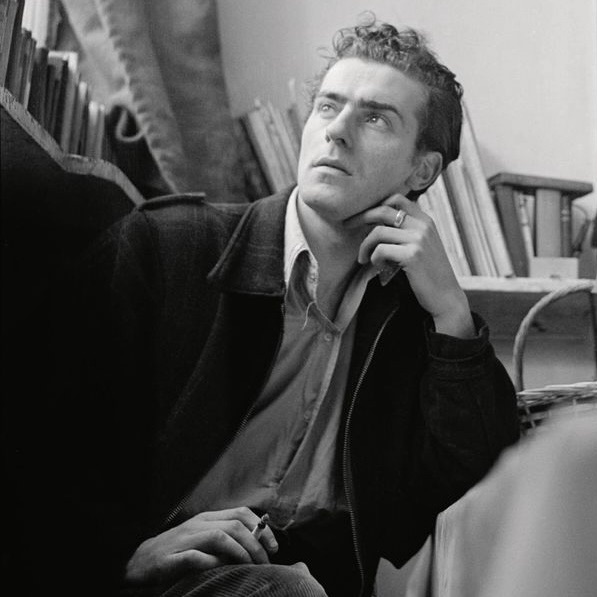
Scottish artist Robert Colquhoun was BOTD in 1914. Born and raised in Kilmarnock to a working-class family, he won a scholarship in 1932 to study at the Glasgow School of Art. He formed a relationship with fellow student Robert MacBryde, who became his lifelong romantic and professional partner. Known as The Two Roberts, they studied and travelled in France and Italy throughout the 1930s, returning to England at the outbreak of World War Two. Colquhoun served as an ambulance driver for the Royal Army Medical Corps, serving on the front lines of battle. After being wounded in 1941, he returned to London and lived with MacBryde. They formed a friendship circle including the artists Francis Bacon, John Minton and Lucian Freud and writers Dylan Thomas, George Barker, Elizabeth Smart and Frank Norman. His early realist portraits of labourers progressed into a more austere and abstract style, influenced by the work of Pablo Picasso. A prolific printmaker, he produced a number of lithographs and monotypes. He and Colquhoun also designed theatrical sets for actor-director John Gielgud and ballet choreographer Léonide Massine. Their careers faltered in the 1950s with the rise of Abstract Expressionism, and they descended into poverty and alcoholism. Colquhoun died in 1962. Largely forgotten at his death, he and MacBryde’s reputations were exhumed by Roger Bristow’s 2009 biography The Last Bohemians. Their relationship formed the basis of Damian Barr‘s 2025 novel The Two Roberts, sparking further interest in their life and work and an exhibition of their work at Charleston House, the former home of Bloomsbury Group artists Vanessa Bell and Duncan Grant.
Robert Colquhoun

 Super Gays Born on this Day