
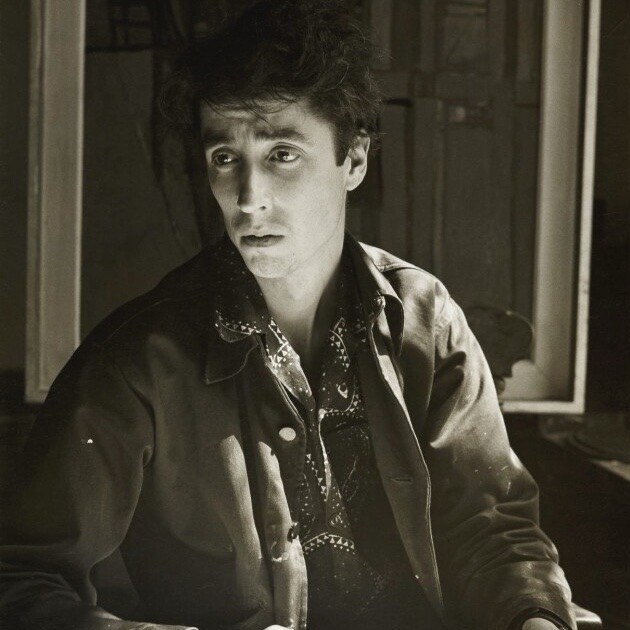
English artist and designer (Francis) John Minton was BOTD in 1917. Born in Great Shelford, Cambridgeshire to a middle-class family, he was educated at private schools before moving to London to study at St John’s Wood School of Art. Encouraged by his friend and fellow student Michael Ayrton, he became interested in 19th century French Neo-Romantic painting, moving with Ayrton to Paris to study art. Returning to England at the outbreak of World War Two, he initially registered as a conscientious objector, then changed his mind and joined the British Army, serving with the Buckinghamshire Light Infantry. While in the Army, he designed the costumes and sets for John Gielgud‘s celebrated 1942 production of Shakespeare‘s Macbeth. Discharged from the Army in 1943 on medical grounds, he returned to London, where he taught drawing and illustration at the Camberwell College of Arts and the Central School of Arts and Design. He socialised a queer artistic circle including Robert Colquhoun and Robert MacBryde, Keith Vaughan and Lucian Freud, living for a time in a ménage-à-trois with Freud and the artist Adrian Ryan. He continued painting in a Neo-Romantic style, heavily influenced by the English artist Samuel Palmer, with much of his work featuring eroticised images of young working-class men. In later life, he became chiefly known as an illustrator, receiving a number of commissions from his friend and possible lover, the publisher John Lehmann, notably the first English-language cookery books by food writer Elizabeth David. He also produced posters for London Transport and Ealing Film Studios. His work fell out of fashion in the post-war period as Abstract Expressionism dominated the art world, leading to depression and an increasing dependence on alcohol. He committed suicide via an overdose of sleeping tablets in 1957, aged 39.
John Minton

 Super Gays Born on this Day