
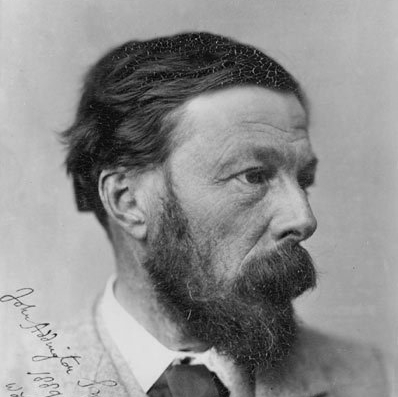
English writer and social theorist John Addington Symonds was BOTD in 1840. Born in Bristol to a prominent middle-class family, he attended Oxford University, where he had a chaste year-long affair with a college choirboy three years his junior. After graduating, he was elected to a fellowship at Magdalen College in 1862, but was accused by a student of attempting to corrupt another choirboy. Symonds was cleared of all charges, but suffered a nervous breakdown, leaving Oxford. He moved to Switzerland, where he met Janet North, marrying her in 1864 and returning to London where they raised four daughters. A prolific writer, he published a seven-volume study Renaissance in Italy and biographies of Percy Shelley, Philip Sidney, Ben Jonson, Michelangelo and Benvenuto Cellini. His writings on male homosexuality defended “male love”, notably his privately-printed 1883 essay A Problem in Greek Ethics, thought to be the first use of the word “homosexual” in English. He also translated Plato’s Symposium and Michelangelo’s homoerotic sonnets. In 1868, Symonds fell in love with 17 year-old student Norman Moor, with whom he had a four-year affair, at one point leaving his family for several months to travel with Moor in Italy. Symonds’ accounts of the relationship are ambiguous, stating that their relationship was sexless, but later describing in his diary “I stripped him naked and fed sight, touch and mouth on these things.” The affair inspired an outpouring of homoerotic poetry, published in 1880 as New and Old: A Volume of Verse. He also corresponded with German gay rights activist Karl Heinrich Ulrichs, Scottish writer Robert Louis Stevenson, and American poet Walt Whitman, whom he badgered to confirm the homoerotic origins of his Calamus poems. His later life was affected by illness, prompting his return to Switzerland where he settled at a sanatorium in Davos. In his final years, he completed his study of the Renaissance, a book of essays In the Key of Blue and a fawning study of Whitman. He returned frequently to Italy, staying in Venice with his former student Horatio Forbes Brown and developing random crushes on gondoliers and other working-class Italian men. Symonds died in 1893 aged 52, leaving an unpublished memoir detailing his bisexuality. His literary executor (and fellow closet case) Edmund Gosse, destroyed all Symonds’ papers, publishing only a heavily censored version of the memoir. In 1896, the sexologist Havelock Ellis included A Problem in Greek Ethics in his book Das konträre Geschlechtsgefühl (Sexual Inversion), failing to attribute authorship to Symonds. Interest in Symonds’ life and work resurged during the gay liberation movement of the 1970s. An unexpurgated version of his memoir was released in 1984, while his first work on homosexuality, Soldier Love and Related Matter, was republished in 2007.
John Addington Symonds

 Super Gays Born on this Day