
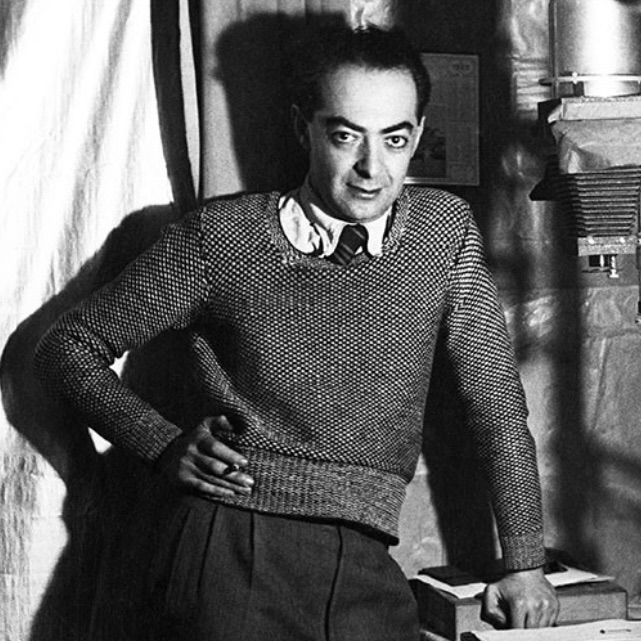
Franco-Hungarian photographer Brassaï was BOTD in 1899. Born Gyula Halász in Brassó, Transylvania, then part of the Austro-Hungarian Empire (now Braşov in Romania), he studied painting and sculpture at the Hungarian Academy of Fine Arts in Budapest. During World War One, he served in the Austro-Hungarian Army. In 1920, he moved to Berlin, working as a journalist and continuing his studies at the Berlin-Charlottenburg Academy of Fine Arts. He moved to Paris in 1924 to pursue a career as an artist, teaching himself French by reading Marcel Proust’s À la recherche des temps perdu. Settling in the bohemian district of Montparnasse, he immersed himself in bohemian life, befriending artists Pablo Picasso, Joan Miró, Salvador Dalí, Henri Matisse, Alberto Giocometti and writers Henry Miller, Anaïs Nin and Jean Genet. He supported himself with journalistic assignments, where he learned to use cameras, and began photographing the nightlife in his neighbourhood, adopting the pseudonym Brassaï in honour of his hometown. His first photography book Paris de nuit (Paris by Night) was published in 1933 to great success, causing a scandal with his frank depictions of drunks, petty criminals and sex workers. Many of his photos featured gay and lesbian subjects, and photos of same-sex couples in drag, dancing together at underground parties. Latterly dubbed “the eye of Paris” by Miller, his style helped popularise the growing trend in street photography. Following the Nazi invasion of France in 1940, Brassaï escaped to the French Riveria, but returned to Paris to rescue negatives he had hidden there. Street photography was banned during the occupation, so he resumed drawing and sculpture, and began writing poetry. After the war, his drawings were published as Trente dessins (Thirty Drawings) to critical acclaim. He resumed his photography work, collaborating with Jacques Prévert on the ballet Le Rendez-vous, in which enlarged prints of his Paris night scenes were used as the backdrop to the dance. The New York Museum of Modern Art held a retrospective of Brassaï’s work in 1948, leading to commissions for Harper’s Bazaar magazine. In the 1970s, he published a number of books of his photographs, including The Secret Paris of the 30’s. His book Artists of My Life, a collection of his photos and written recollections of his friendships with Miller and others, was published in 1982. Braissaï married Gilberte-Mercédès Boyer in 1948, who assisted him on many of his photographic projects. They remained together until his death in 1984, aged 84. He earns Honorary SuperGay status for his candid and non-judgmental portrayal of Paris’s underground LGBTQ community, and the distinctly queer outsider’s gaze of his work.
Brassaï

 Super Gays Born on this Day