
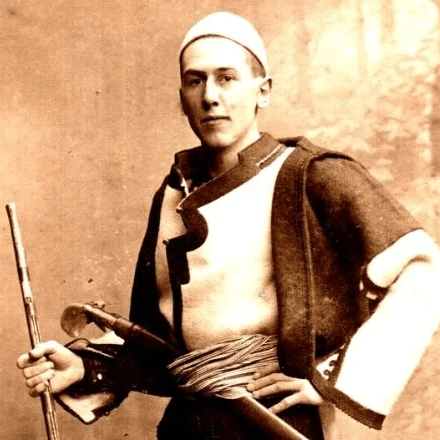
Hungarian aristocrat, paleontologist, writer and murderer Baron Franz Nopcsa von Felső-Szilvás was BOTD in 1877. Born in Déva, Transylvania in present-day Romania (then part of the Kingdom of Hungary) to an aristocratic family, he was raised in his family’s estate at Săcel. He was educated in Vienna, developing an early interest in paleontology after his sister found dinosaur bones on their estate. He studied geology at the University of Vienna, geologically mapping his family’s property as part of his PhD doctorate. In 1906 he travelled to Bucharest, where he met the 18 year-old Armenian writer Bajazid Elmaz Doda. They became lovers, with Nopcsa hiring Doda as his secretary to legitimise their relationship. They lived variously at Nopcsa’s estate in Săcel and in London before travelling together to Albania, at the time part of the Ottoman Empire. During their travels, Nopsca produced the first geological map of the North Balkan region, while Doda took photographs of local tribes, both offering support to the burgeoning Albanian independence movement. In 1907, they were both taken hostage by the bandit Mustafa Lita, until being rescued by Doda’s father, who had assembled twelve armed retainers. After their release, they moved to Shkodër, living together for several years. When Albania achieved independence in 1912, Nopcsa offered to become king, proposing to marry an American heiress to raise funds for the war effort, “a step which under other circumstances I would have been loath to take“. (Perhaps unsurprisingly, his offer was declined). During World War One, Nopcsa and Doda moved to Kosovo while Nopcsa worked as a spy for the Austro-Hungarian army. After the war, they lived mainly in Vienna, where Nopcsa became well-known as a writer and researcher. At the end of the war, Transylvania became part of Romania, and Nopcsa lost his title and income. He worked briefly for the Hungarian Geological Institute in 1925, then travelled through Europe with Doda for three years studying fossils. He discovered and named several species of dinosaur, developing theories about their physiology, behaviour and evolutionary development, becoming a pioneer in the emerging field of paleobiology. Returning to Vienna financially destitute, he sold his fossil collection to the Natural History Museum in London. His physical and mental health deteriorated, confining him to a wheelchair by 1929 and limiting his ability to travel and work. In 1933, he drugged and shot Doda in his sleep and then shot himself. He was 55. In his suicide, he explained that he killed Doda because he “did not wish to leave him behind sick, in misery and without a penny, because he would have suffered too much.” Nopcsa’s diaries, scientific papers and an unfinished memoir (the latter published in 2001) became invaluable resources in the fields of paleontology, paleobiology, geology and Albanian studies, and are now archived in the National Library of Albania.
Franz Nopcsa von Felső-Szilvás

 Super Gays Born on this Day