
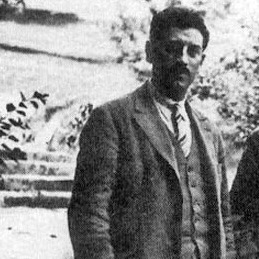
Albanian ethnographer and photographer Bajazid Elmaz Doda was born in 1888 and died on this day in 1933. Born in Štirovica in North Macedonia, at the time part of the Ottoman Empire, little is known of his early life. He moved to Bucharest to find work. In 1906, aged 18, he became the lover of the Hungarian aristocrat and paleobiologist Baron Franz Nopcsa von Felső-Szilvás, who hired him as his secretary to legitimise their relationship. In 1906 he travelled to Bucharest, where he met the 18 year-old Armenian Bajazid Elmaz Doda. They became lovers, with Nopcsa hiring Doda as his secretary to legitimise their relationship. They lived variously at Nopcsa’s estate in Săcel and in London before travelling together to Albania, at the time part of the Ottoman Empire. During their travels, Nopsca produced the first geological map of the North Balkan region, while Doda took photographs of local tribes, both offering support to the burgeoning Albanian independence movement. In 1907, they were both taken hostage by the bandit Mustafa Lita, until being rescued by Doda’s father and a gang of 12 armed retainers. After their release, they moved to Shkodër, living together for several years. During World War One, Nopcsa and Doda moved to Kosovo while Nopcsa worked as a spy for the Austro-Hungarian army. After the war, they lived mainly in Vienna, where Nopcsa became well-known as a writer and researcher. Doda is best known for his 1914 book Albanisches Bauerleben im oberen Rekatal bei Dibra (Makedonien) (Albanian Peasant Life in the Upper Reka Valley near Dibra (Macedonia)), containing detailed information about rural Albanian Muslim communities, practices and languages. Accompanied by photographs of the villages of Štirovica and Skopje, it is thought to be the first written work to record Upper Reka Albanian dialect. At the end of the war, Transylvania became part of Romania, and Nopcsa lost his title and income. He worked briefly for the Hungarian Geological Institute in 1925, then travelled through Europe with Doda for three years studying fossils. Nopcsa’s physical and mental health deteriorated, confining him to a wheelchair by 1929 and limiting his ability to travel and work. In 1933, he drugged and shot Doda in his sleep and then shot himself, explaining in a suicide note that he killed Doda because he “did not wish to leave him behind sick, in misery and without a penny, because he would have suffered too much.” News reports at the time stated that Doda was 45. Doda’s writings and photographs, unpublished in his lifetime, were re-discovered in Nopcsa’s archives and published in 2007, providing valuable insights into rural Albanian culture.
Bajazid Elmaz Doda

 Super Gays Born on this Day