
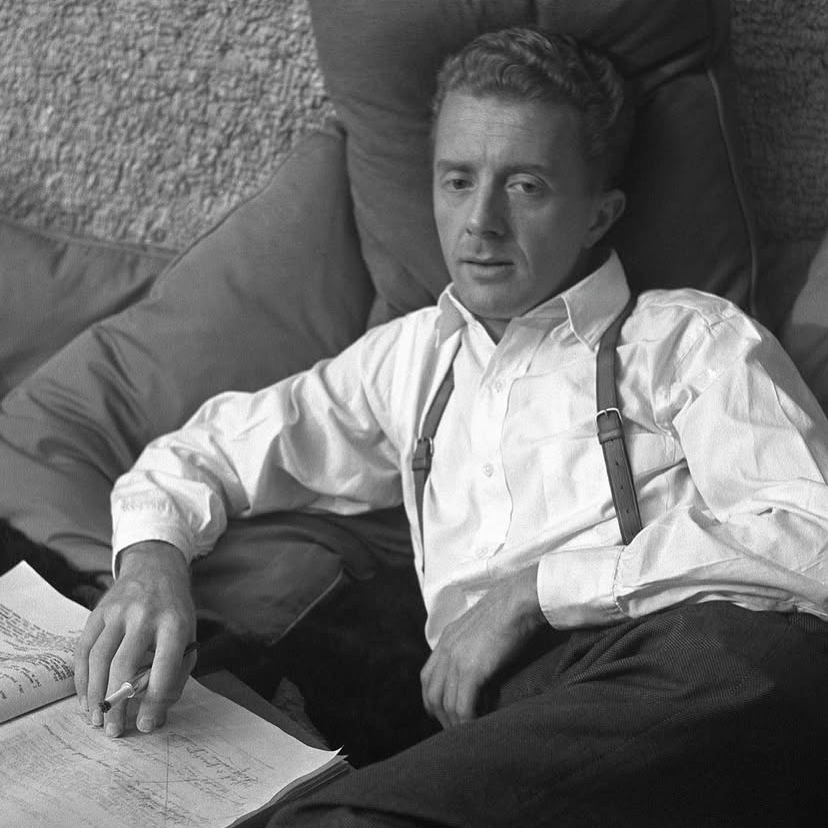
American writer and composer Paul Bowles was BOTD in 1910. Born in New York City to wealthy middle-class parents, he composed poetry and music from an early age, publishing his first poem at 17. While studying at the University of Virginia, he made a number of trips to Paris with his lover and teacher Aaron Copland, where they befriended celebrity lesbians Gertrude Stein and Alice B. Toklas. On Stein’s recommendation, they travelled to Tangier in 1931. Bowles also met the writer Christopher Isherwood, who later named his most famous literary creation Sally Bowles in his honour. He returned to New York in 1937, working as a composer and collaborating on writing projects with Orson Welles and Tennessee Williams. In 1938, he married fellow writer Jane Auer. They had an open marriage, each pursuing same-sex affairs while remaining emotionally devoted to each other. Central figures in the New York avant-garde scene, their largely gay friendship circle included Williams, Lincoln Kirstein, Virgil Thompson, Ned Rorem, John Cage, Merce Cunningham, Frank O’Hara and Leonard Bernstein. Bowles and Auer moved to Tangier in 1947 where he completed his first novel The Sheltering Sky. Published in 1949, its themes of marital unrest, existential ennui and sexual violence caused an international sensation, vaulting him to literary celebrity. They remained in Tangier, welcoming Bowles’ many celebrity friends including Isherwood and his young lover Don Bachardy, Truman Capote, Gore Vidal, William S. Burroughs, Allen Ginsberg and Gregory Corso. His later work includes the novels Let It Come Down and The Spider’s House, collections of short stories and musical compositions. He also undertook translations of Moroccan writers, and spent three years recording indigenous Moroccan music. Bowles cared for Auer for many years until her death in 1973. He also had a series of relationships with teenage Moroccan boys, including Ahmed Yacoubi and Mohammed Mrabet. Bernardo Bertolucci’s 1990 film version of The Sheltering Sky, featuring Bowles in a cameo role, brought renewed interest in his work, followed by a 1998 documentary Let It Come Down. He died in 1999, aged 88.
Paul Bowles

 Super Gays Born on this Day