
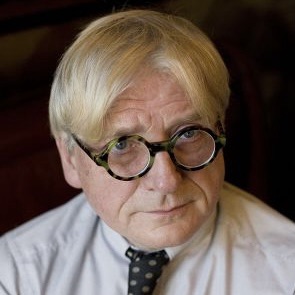
Scottish writer and journalist Gilbert Adair was BOTD in 1944. Born in Edinburgh, he studied French at the University of Glasgow. After graduating, he moved to Paris, where he witnessed the student riots and protests of May 1968, imbibed the writings of postmodernist theorists Roland Barthes, Gilles Deleuze, Félix Guattari and Michel Foucault, befriended fellow expatriate David Hockney and became a cinephile via regular attendance at the Cinémathèque Française. He began his literary career writing children’s fiction, including 1984’s Alice Through the Needle’s Eye, an unofficial sequel to Lewis Carroll’s Alice’s Adventures in Wonderland, followed by Peter Pan and the Only Children, a pastiche of J. M. Barrie‘s Peter Pan stories. He rose to wider public attention with his 1988 debut novel The Holy Innocents, a psychodrama about a young American man who enters into a ménage-à-trois with a French brother and sister, loosely based on Jean Cocteau‘s novella Les Enfants Terribles but updated to May 1968. The book’s success led to regular work as a columnist and film critic for The Sunday Times and The Independent on Sunday. His 1995 book A Void, translated from George Perec’s novel La Disparition (which, like Perec’s original, omitted all use of the letter “e”) won the Scott Moncrieff Prize for literary translation. He is best known for his 1990 novel Love and Death on Long Island, an update of Thomas Mann‘s novella Death in Venice, in which a reclusive English writer falls in love with a young American soap opera actor. Filmed in 1997 by Richard Kwietniowski, starring John Hurt and Jason Priestley and with a screenplay by Adair, it premiered at the Cannes Festival to critical acclaim. He also adapted The Holy Innocents into Bernardo Bertolucci’s 2003 film The Dreamers, appearing briefly in a scene in the Louvre Museum. Later in life, he collaborated on screenplays for Raúl Ruiz’s films The Territory, Klimt and A Closed Book, wrote a series of pastiches of Agatha Christie detective stories and a biography of Władysław Moes, the supposed inspiration for the young object of desire in Death in Venice. Adair’s essays and reviews were collated in the books A Night at the Pictures, The Postmodernist Always Rings and Twice Surfing the Zeitgeist. Openly gay since forever, little is known about his personal life or relationships. He died in 2011, aged 66.
Gilbert Adair

 Super Gays Born on this Day