
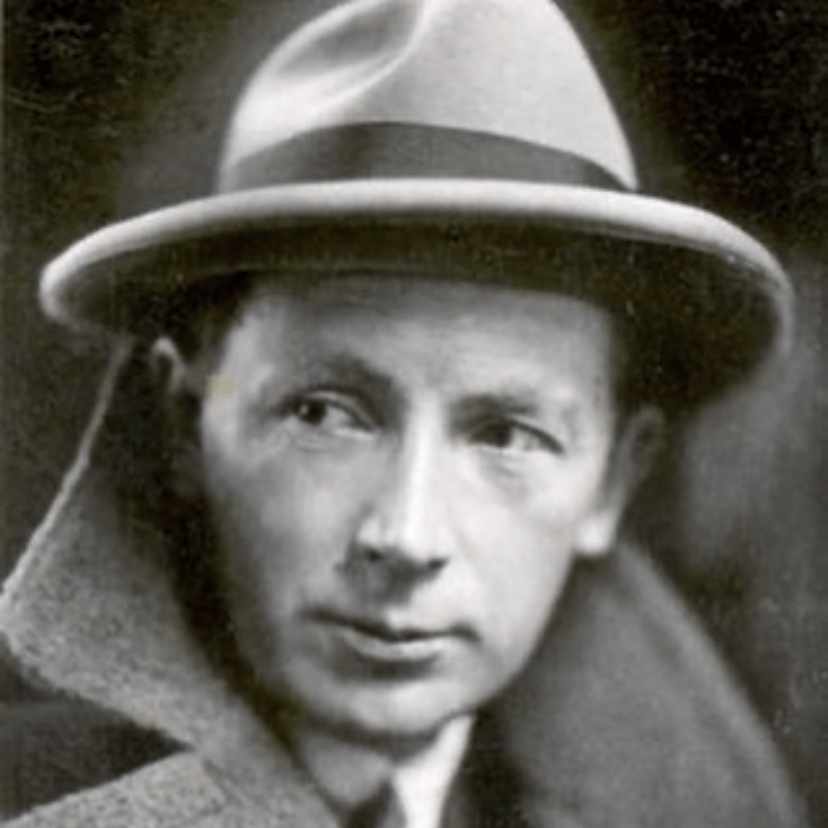
German filmmaker Friedrich Wilhelm (F. W.) Murnau was BOTD in 1888. Born in the Rhineland, he showed an early interest in theatre, befriending director Max Reinhardt while he was at university. He served in the German Army during World War One, surviving many attacks but left dependent on opium, and was interred in a Swiss prisoner-of-war camp. After the war, he returned to Berlin and opened a film studio with his friend (and probable lover) Conrad Veidt. After successes with the feature films Der Knabe in Blau (The Boy in Blue) and the Jekyll & Hyde story Der Janus-Kopf (The Head of Janus), he made his best-known film Nosferatu, eine Symphonie des Grauens (Nosferatu, a Symphony of Horror), an adaptation of Bram Stoker’s novel Dracula starring Max Schreck as the vampire Count Orlok. Stoker family subsequently sued Murnau sued for copyright infringement, and all copies of the film were ordered to be destroyed, though one print survived. His 1934 films Der letzte Mann (The Last Laugh) and Faust, both starring Emil Jannings, were notable for their innovative camera work and use of original scores, but were commercial failures. Despondent, Murnau emigrated to Hollywood in 1926, where he made the psychological drama Sunrise: A Song of Two Humans for Fox Film Studios, starring Janet Gaynor. Though not commercially successful, the film was highly praised, winning Oscars for best picture and for Gaynor at the first Academy Awards ceremony in 1929. Murnau’s first talking pictures, 4 Devils and City Girl, also made for Fox, were not successful. A disgruntled Murnau relocated to the South Pacific, where he made the Orientalist romance Tabu. In 1931, a week before the film’s opening, Murnau died of injuries sustained in a car accident. He was 42. An apocryphal rumour, eagerly spread by Kenneth Anger in his book Hollywood Babylon, claimed that Murnau was performing oral sex on his chauffeur Eliazar Garcia Stevenson at the time of the car accident. Greta Garbo, one of the few attendees at Murnau’s funeral, had a death mask made of his face, which she reportedly kept on her desk. Murnau is now considered one of the greatest directors of the silent era, credited with incorporating German Expressionist techniques into Hollywood film. He was played by John Malkovich in the 2000 film Shadow of the Vampire, in which Murnau hires a real vampire to play Count Orlok in Nosferatu.
F. W. Murnau

 Super Gays Born on this Day