
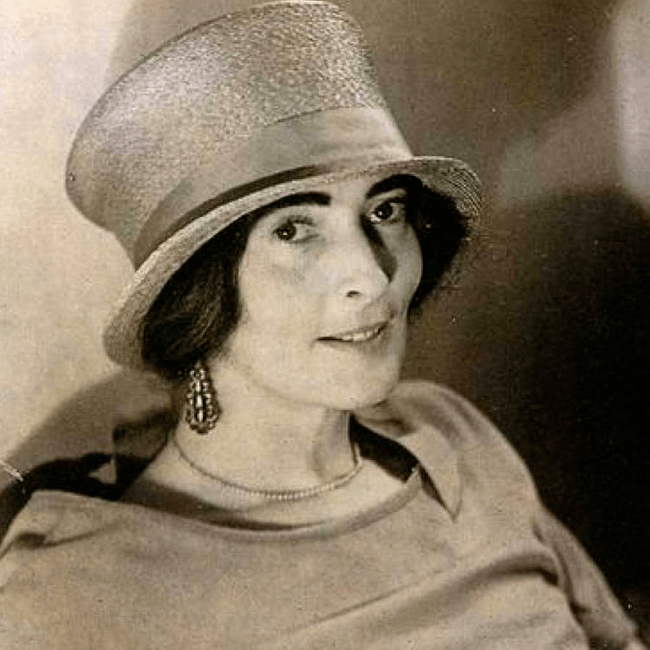
English artist, writer and designer Mina Loy was BOTD in 1882. Born in London, to a Hungarian Jewish father and an English mother, she had a difficult childhood due to her parents’ troubled marriage and her mother’s virulent anti-Semitism. She studied art at St John’s Wood School, where she became obsessed with Pre-Raphaelite artists Dante Gabriel Rossetti, William Morris and Edward Burne-Jones and the poetry of Christina Rossetti. In 1900, she escaped to Munich, where she studied at the Künstlerinnenverein (Society of Female Artists’ School), moving to Paris in 1902 to attend the Académie Colarossi. While in Paris, she fell under the influence of English painter Stephen Haweis, who borrowed money from her and eventually raped and impregnated her. At her parents’ insistence, Loy married Haweis in 1903, giving birth to their daughter five months later. The marriage was unhappy, marked by Haweis’ infidelities and the death of their daughter in 1904. Loy studied watercolour painting at the Salon d’Automne in 1905, exhibiting her work at the Salon des Beaux-Arts. After agreeing to separate from Haweis in 1906, she sought treatment for neurasthenia, having an affair with her doctor and again becoming pregnant. An infuriated Haweis insisted that they move together to Florence, where Loy gave birth to a son, and had another child with Haweis. They had an open marriage, socialising within an expatriate Anglo-American community including celebrity lesbians Gertrude Stein, who encouraged her to write poetry. Loy became involved with Futurist artists Filippo Marinetti and Giovanni Papini, with whom she was briefly involved in a ménage-à-trois. Frustrated with the misogyny of the Futurist movement, she wrote a Feminist Manifesto, which remained unpublished in her lifetime. In 1916, she left Haweis and her children and travelled to the United States. Settling in New York City, she became a fixture of the Greenwich Village avant-garde scene, befriending artists Man Ray and Marcel Duchamp and poets William Carlos Williams, Marianne Moore and Wallace Stevens. In 1917, she had an affair with the “poet-boxer” Arthur Craven, eloping with him to Mexico where they were married in 1918. Shortly after she became pregnant, Craven disappeared and was presumed drowned. Loy travelled to England to await the birth of her daughter, before returning to New York, continuing to write and publish poetry. Her writing dealt unflinchingly with childbirth, sex and disillusionment in marriage: her best known poem, Songs to Jannes, exhorted women to free themselves of emotional and physical dependence on men. Her work was praised by Stein, T. S. Eliot and especially Ezra Pound, who coined the term “logopoeia” to describe her cool, affectless style. She moved to Paris in 1923, where she published her first poetry collection Lunar Baedecker. At the outbreak of World War Two, she returned to New York, living in the Bowery and making object assemblage art. She became a naturalised American citizen, moving to Aspen, Colorado to live with her daughters and publishing a second poetry collection, Lunar Baedeker & Time Tables, in 1958. She died in 1966, aged 83. Much of her work was published after her death, including her Feminist Manifesto and a novel, Insel. Though heterosexual, her close identification with feminist thought and the lesbian avant-garde earn her Honorary SuperGay Status.
Mina Loy

 Super Gays Born on this Day