
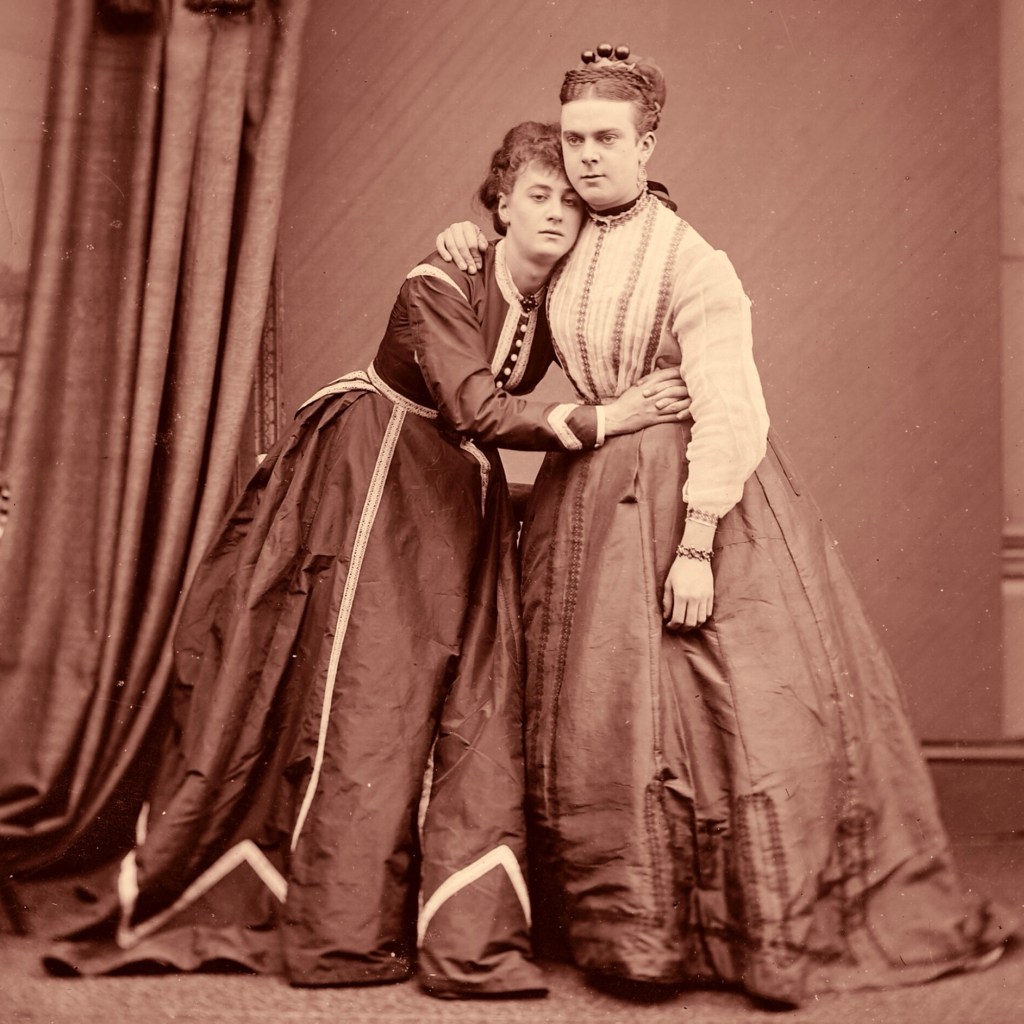
English performer and cross-dresser Thomas Ernest Boulton was BOTD in 1847. Born in Tottenham to a wealthy mercantile family, he cross-dressed from early childhood, frequently being mistaken by visitors as a parlourmaid. After a brief, unsuccessful attempt by his father to find him a position as a bank clerk, he became a regular cross-dresser around central London, typically accompanied by his friend and roommate Frederick Park. Nicknamed “Fanny” and “Stella”, they became well-known in London society, performing in a travelling theatrical troupe and attending the 1869 Oxford and Cambridge Boat Race. Historians have also speculated that Boulton and Park were sex workers, though little evidence exists to support this. In the late 1860s, Boulton formed a relationship with the politician Lord Arthur Clinton, referring to himself as Boulton’s wife and having calling cards printed reading “Lady Arthur Clinton”. Clinton later joined them on tour, appearing on stage with Boulton and kissing him on the lips, apparently without attracting comment. Placed under surveillance by the London police force, Boulton and Park were arrested in 1870 and charged with conspiracy to commit sodomy. Both were remanded in prison for two months and subjected to intrusive physical examinations by doctors. Their trial became a media sensation, generating significant publicity about the then-unknown queer underworld of London. Both were acquitted of sodomy, though pled guilty to the lesser charge of offending public morals. The trial judge was highly critical of the police investigation and Boulton and Park’s abusive treatment by the police surgeon. After their release, they returned to stage performances, travelling to New York in 1874 where they appeared at the Fifth Avenue Theatre, both presenting as men. Little is known of Boulton’s later life, though he is thought to have reunited with Clinton in New York. He died of a brain tumour in 1904, aged 56. Boulton and Park’s trial was key to the establishment of a “homosexual identity” in 19th century Britain, and was the first recorded use of the word “drag” to refer to cross-dressing. Their acquittal exposed the failures in the current criminal law to prosecute homosexual activity, prompting the 1885 Labouchère Amendment, introducing the more wide-reaching offence of “gross indecency”. They became cult figures in Victorian society, inspiring the cross-dressing sex workers “Laura” and “Selina” in the erotic novel The Sins of the Cities of the Plain (a text attributed to celebrity rent boy Jack Saul, but probably written by Simeon Solomon) and several popular stories and limericks. Their lives and legacy have been extensively analysed by historians, inspiring biographies and critical studies by H. Montgomery Hyde, Jeffrey Weeks, Neil Bartlett, Neil McKenna and Matt Cook. In recent years, they have been reappraised as early examples of transgender identity.
Thomas Boulton

 Super Gays Born on this Day