
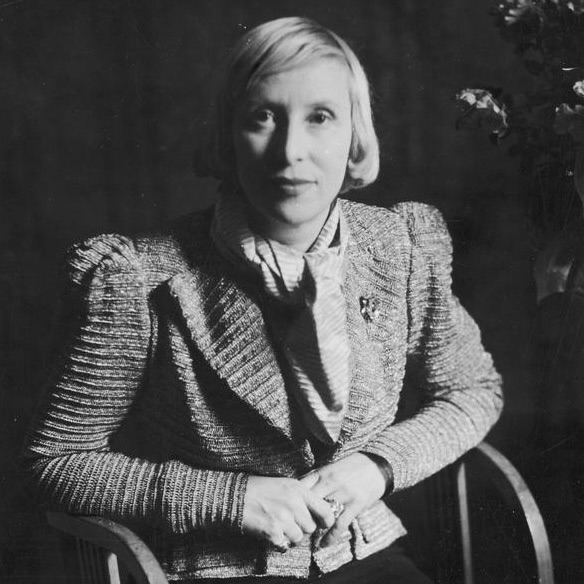
French singer, nightclub owner and writer Suzy Solidor was BOTD in 1900. Born Suzanne Marion in Saint-Servan-sur-Mer, Normandy to an unknown father, she was was raised by her mother and stepfather. Independent from an early age, she obtained her driver’s licence as a teenager, and drove ambulances on the front lines of battle during World War One. After the war, she settled in Paris, forming a relationship with antique dealer and celebrity lesbian Yvonne de Bremond d’Ars, who introduced her to Parisian society, helping sculpt her persona as a glamorous androgyne. In 1929, she began a career as a singer, making her professional debut at a cabaret in Deauville, changing her surname in tribute to her childhood neighbourhood. She became a popular nightclub act, famous for her deep masculine voice (described by celebrity fan Jean Cocteau as “a voice that comes from the genitals”) and her repertoire of sea shanties, earning her the nickname “l’Amiral” (“the Admiral”). Openly and exotically queer, she also become well-known for her ballads celebrating lesbian love, notably Ouvre, ou Obsession. After separating from Bremond d’Ars in 1931, Solidor pursued relationships with men and women, notably the aviator Jean Mermoz. In 1932, she opened La Vie Parisienne, an exclusive nightclub and cabaret, which became a mecca for Paris’ queer and artistic communities. Aspiring to become the most painted woman in France, she commissioned over 200 portraits from artists including Cocteau, Francis Picabia, Man Ray and Tamara de Łempicka (with whom she had a brief affair), displaying the portraits in her nightclub. In 1936, she appeared in the film adaptation of Victor Margueritte’s scandalous novel La Garçonne, further adding to her cult appeal. Following the Nazi occupation of France in 1940, she continued running her cabaret, adding a French-language version of the song Lili Marleen to entertain German troops, and regularly performed for Nazi-controlled radio stations. She also wrote and published four novels, Térésine, Fil d’or, Le Fortuné de l’Amphitrite and Le vie commence au large. After the liberation of France, she was tried before the Commission d’Épuration des milieux artistiques, a civilian-led court established to “purify” artistic circles, receiving a reprimand and a five-year ban on performing or running a business. She passed the management of her cabaret to a friend and moved to the United States, where she resumed her singing career. Returning to Paris in 1954, she opened a new cabaret, Chez Suzi Solidar, again decorated with her portraits. In 1957, she commissioned Francis Bacon to paint her portrait, but hated the result, selling it back to Bacon who later destroyed it. She moved to Cagnes-sur-Mer in the Côte d’Azur in 1960, where she opened Chez Suzy, performing there until 1967, before retiring and running an antiques shop. In 1973, she donated 40 of her most famous portraits to the township, which formed an extremely strange permanent exhibition in Le Château Grimaldi. She died in 1983, aged 82.
Suzy Solidor

 Super Gays Born on this Day