
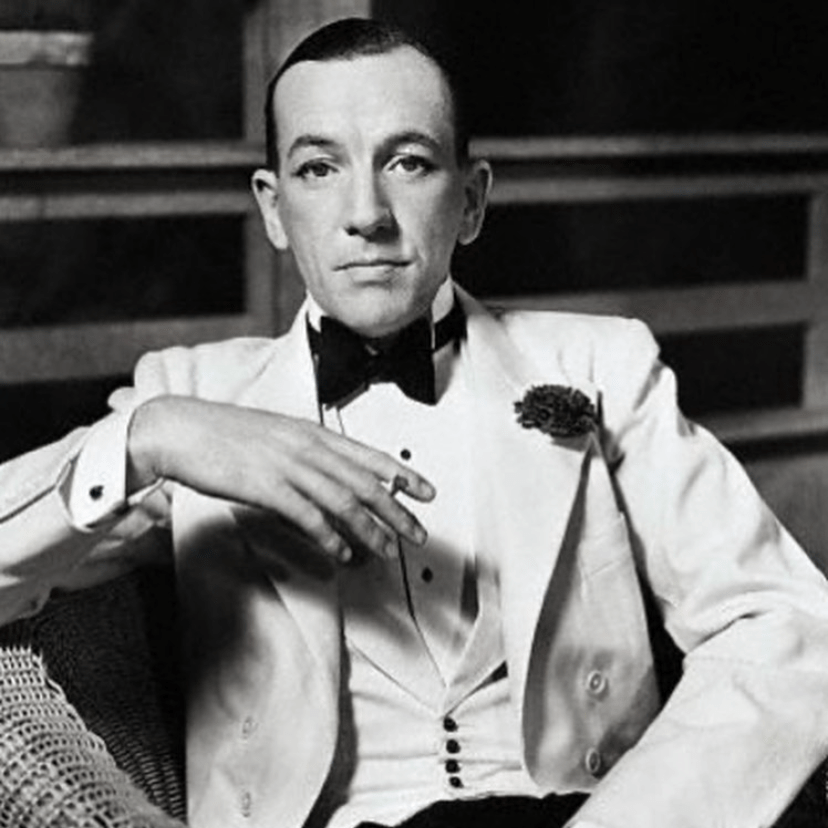
English singer-songwriter, playwright, director and socialite Noël Coward was BOTD in 1899. Born in Teddington in suburban London, his ambitious mother groomed him for the stage, and he became a child actor, making his professional debut in the West End when he was 12. His breakthrough was his 1924 play The Vortex, which he wrote and starred in, a controversial drama about drug-addicted aristocrats that became a hit in London and New York. He burned through the interwar years, writing, producing and starring in a series of witty comedies including Fallen Angels, Hay Fever, Easy Virtue, Private Lives, Design for Living, Blithe Spirit and Present Laughter, making him the most successful British playwright since Oscar Wilde and a popular theatre star. Many of his best roles were written for his friend Gertrude Lawrence, with whom he frequently co-starred, becoming a beloved theatrical double-act. During World War Two, Coward worked for British intelligence, undertook gruelling tours performing for Allied troops abroad, and wrote, directed and starred in the rousing war drama In Which We Serve, winning him an honorary Oscar. He scored a huge success with the screenplay for David Lean’s 1945 film Brief Encounter, a quietly heart-breaking tale of a suburban extra-marital affair, now considered the definitive portrait of sexually repressed Englishness. In the 1950s, he reinvented himself as a cabaret act, taking Las Vegas by storm in a series of highly successful concerts, showcasing his hit songs including Mad About the Boy, Mad Dogs and Englishmen, I Went to a Marvellous Party, Twentieth Century Blues and There Are Bad Times Just Around the Corner. He made a startling cameo as the Witch of Capri in Joseph Losey‘s 1968 film Boom!, a calamitous adaptation of Tennessee Williams‘ play The Milk Train Doesn’t Stop Here Anymore, though had better success in the macho heist film The Italian Job. Fruity in public but discreet about his private life, he had a series of older lovers in his youth who helped promote his career, including society painter Philip Streatfeild and theatrical producer Jack Wilson, and clocked up affairs with composer Ned Rorem, actors Alan Webb and Louis Hayward, playwright Keith Winter, and Prince George, Duke of Kent. He lived for 30 years with South African-born actor Graham Payn, until his death in 1973, aged 73. Coward never publicly acknowledged his homosexuality in his lifetime (“There are still a few old ladies in Worthing who don’t know”, he once quipped), but typified a Wildean model of wit and sophistication that was hugely influential on public perceptions of homosexuality. A tax exile from Britain since the 1950s, he had homes in Switzerland and Jamaica, where he maintained a formidable social life. His diaries, published by Payn in 1982, recorded his interactions with luminaries including Cecil Beaton, Winston Churchill, Queen Elizabeth the Queen Mother, Princess Margaret, Lord Mountbatten, John Gielgud, Marlene Dietrich (with whom he was rumoured to have an affair), Laurence Olivier, Vivien Leigh, Alfred Lunt and Lynn Fontanne, Claudette Colbert, Mary Martin, Lauren Bacall, David Niven, Elaine Stritch, Frank Sinatra, Elizabeth Taylor, Richard Burton, Julie Andrews, Joan Sutherland and Richard Bonynge. His comedies continue to be performed worldwide, while his work has undergone a critical reappraisal by gay scholars, noting the despairing voice of the gay outsider lurking behind his sharpest one-liners. The 1998 tribute album Twentieth Century Blues, produced by Neil Tennant, featured interpretations of Coward’s songs by contemporary artists including the Pet Shop Boys, Elton John, Bryan Ferry, Marianne Faithfull, Paul McCartney, Robbie Williams, Suede and The Divine Comedy, with profits donated to the Red Hot AIDS Charitable Trust.
Noël Coward

 Super Gays Born on this Day