
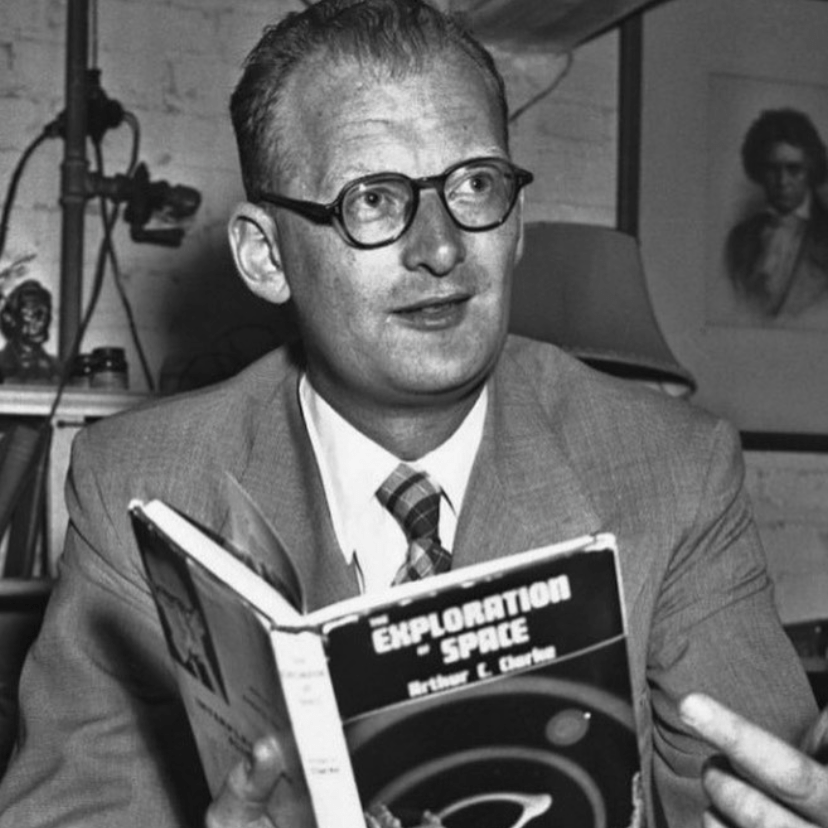
English writer, broadcaster and theorist Arthur C. Clarke was BOTD in 1917. Born in Somerset, he developed an early interest in science fiction, astronomy and space travel. During World War Two, he served in the Royal Air Force, working on the early use of radar defence and guidance systems. After the war, he studied mathematics and physics, and became president of the British Interplanetary Society, publishing influential theories about satellites, space travel and the rise of computers. He became famous for his many works of science fiction, including The City and the Stars and A Fall of Moondust. He co-wrote the screenplay for Stanley Kubrick’s 1968 film 2001: A Space Odyssey, based on his own 1948 story The Sentinel. The film’s innovative depiction of space travel and malevolent artificial intelligence was hugely influential both in cinema and the development of science fiction. In 1969, Clarke was a commentator for the CBS news broadcast of the Apollo 11 moon landing. His 1980s television series Arthur C Clarke’s Mysterious World were also highly popular. Clarke was briefly married to Marilyn Mayfield, with whom he had a son, but separated after six months. In 1956, he immigrated to Ceylon (now Sri Lanka), which had more tolerant attitudes to homosexuality. Discreetly gay, he had a long-term relationship with Sri Lankan Leslie Ekanayake until the latter’s death in 1977. In 1998, the Sunday Mirror reported that Clarke paid underage Sri Lankan boys for sex, leading to the cancellation of the British government’s plans to award him a knighthood. The accusations were later dismissed following an investigation by Sri Lankan police, and the Mirror published an apology. Clarke was knighted in 2000. He died in 2008, aged 90. Among many posthumous tributes are awards for science writing and contributions to space exploration. An asteroid, species of dinosaur and a mountain on Pluto’s moon Charon have been named in his honour.
Arthur C. Clarke

 Super Gays Born on this Day