
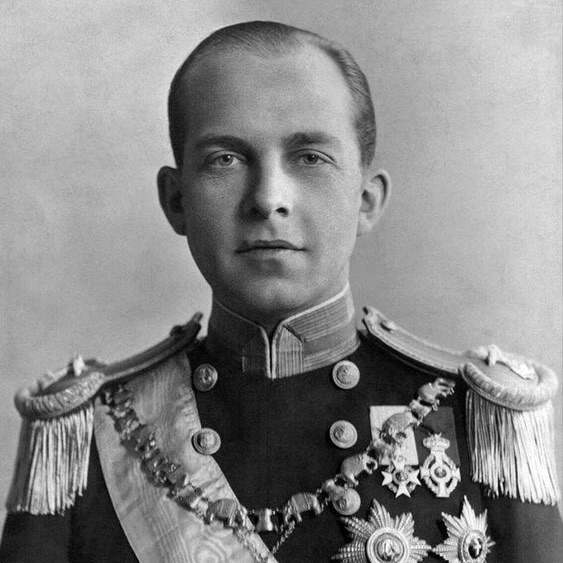
Greek monarch and socialite King Paul of Greece was BOTD in 1901. Born in Athens, the third son of King Constantine I of Greece, he joined the Royal Hellenic Navy aged 11, becoming the force’s youngest-ever cadet. In 1917, during World War One, Constantine was forced to abdicate in favour of his son Alexander, and the family went into exile in Switzerland. After Alexander’s death in 1920, Constantine was restored as monarch and the family returned to Greece, ruling until his death in 1922. Paul’s second brother George became king until a referendum in 1924 led to the abolition of the monarchy. Paul and his family fled to Italy and later moved to England, settling in London, where Paul became a renowned socialite and playboy, befriending the notorious homosexual Evan Morgan, 2nd Viscount Tredegar. While attending a weekend house party at Tredegar’s country estate in Wales, Paul became infatuated with Tredegar’s young lover, American celebrity rent boy Denham Fouts, whisking Fouts away for a cruise around the Mediterranean. In 1935, the Greek monarchy was reinstated following a further referendum and George was restored as king, with Paul as the heir presumptive. Now obliged to marry and produce an heir, he proposed to Princess Frederica of Hanover in 1936, with whom he had three children. His marriage to a German was highly controversial in Greece, as was the presence of celebrity wedding guest Adolf Hitler. After the Nazi invasion of Greece in 1941, Paul and his family were forced into exile in Egypt, eventually leaving Frederica and his children in South Africa while he and George returned to London for the remainder of the war. In 1946, a third referendum once again restored the monarchy, and George returned to Greece as king. Following George’s death in 1947, Paul ascended the throne, overseeing the successful defeat of republican forces during the Greek Civil War with the aid of American forces. As monarch, he oversaw Greece’s transition towards parliamentary democracy, though was accused of despotism after reserving significant monarchial powers in the 1952 Greek Constitution, and secured funding from the US government under the Marshall Plan, significantly increasing Greece’s economic recovery after the war. His support of enosis (Greek nationalism) led to diplomatic arguments with Britain over the sovereignty of Cyprus, culminating in the island becoming an independent republic in 1959. He also attempted to promote the tourist industry, inviting European Royal families on a highly-publicised cruise of the Greek islands, marketed as “Cruise of the Kings”. He reigned until his death from stomach cancer in 1964, aged 62, and was succeeded by his son Constantine II.
King Paul of Greece

 Super Gays Born on this Day