
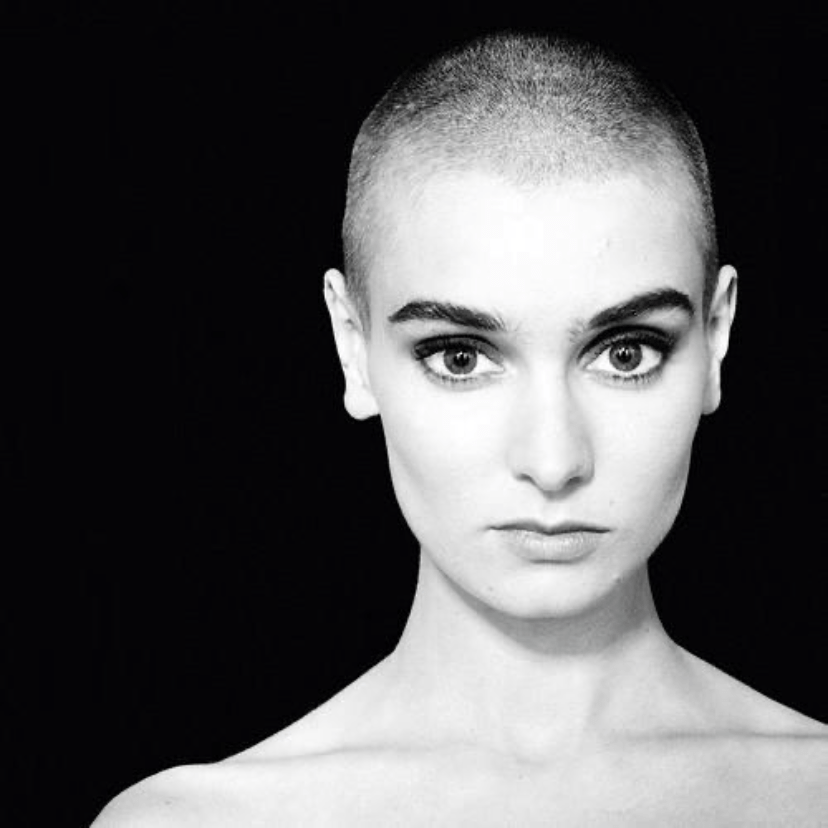
Irish singer-songwriter and actress Sinéad O’Connor was BOTD in 1966. Born in Dublin, she had a turbulent childhood, marked by her father abandoning the family and her mother’s physical and mental abuse. She lived with her father and stepmother in her teens, though her delinquent behaviour caused her to be placed in a Magdalene asylum, where a teacher encouraged her to become a musician. After a year in a boarding school in Waterford, she ran away to Dublin, where she performed in pub-rock band. Signed by Ensign Records, she released her 1987 debut album The Lion and the Cobra, earning praise for her powerful, punk-rock inspired vocals, confessional lyrics about sexuality, patriotism and religion and her famously shaven head. She became an international star with her 1990 album I Do Not Want What I Have Not Got. Her cover of the Prince-penned ballad Nothing Compares 2 U, accompanied by John Maybury‘s music video with O’Connor tearfully singing in extreme close-up, became an international No 1 Hit. She later featured in the influential Cole Porter tribute album Red Hot + Blue, adding her vocal support to HIV/AIDS research, and was adroitly cast as Emily Brontë in a 1992 film of Brontë’s novel Wuthering Heights. O’Connor’s career was punctuated by her bold and often controversial political statements, including her condemnation of the music industry (resulting in her rejecting her Grammy win for Best Alternative Music Performance) and her support for the Irish Republican Army. In 1992, she was publicly condemned after tearing up a photograph of Pope John Paul II during a live performance on Saturday Night Live, in protest at the Catholic Church’s cover-up of child sexual abuse. Her follow-up album Am I Not Your Girl?, a compilation of jazz standards and torch songs, received limited publicity and mixed reviews. After the release of her 1994 album Universal Mother, she took an extended hiatus from public life to raise her children, and appeared as the Virgin Mary in Neil Jordan’s film The Butcher Boy. In 1999, she was ordained as a priest in the Catholic-splinter sect the Latin Tridentine Church, somewhat confusingly coming out as a lesbian the following year. She re-emerged in 2000 with the album Faith and Courage to critical praise, going on to collaborate with musicians including Peter Gabriel, The Chieftains, Massive Attack and John Grant. Married and divorced four times and with four children, she identified variously as straight, lesbian and queer, and acknowledged a number of relationships with women. In 2019, she again mystified her fans by converting to Islam, changing her name to Shuhada Sadaqat. Her memoir Rememberings was published in 2021. She relocated to London in 2023, dying suddenly of complications caused by chronic obstructive pulmonary disease. She was 56. Her death inspired an outpouring of grief around the world, and a more favourable re-assessment of her advocacy for victims of sexual abuse. Now recognised as one of the most influential female musicians of the 20th century, she has inspired generations of performers including Dolores O’Riordan, Michael Stipe, PJ Harvey, Tori Amos, Fiona Apple, Miley Cyrus, Anohni, Tegan & Sara and Janelle Monáe.
Sinéad O’Connor

 Super Gays Born on this Day