
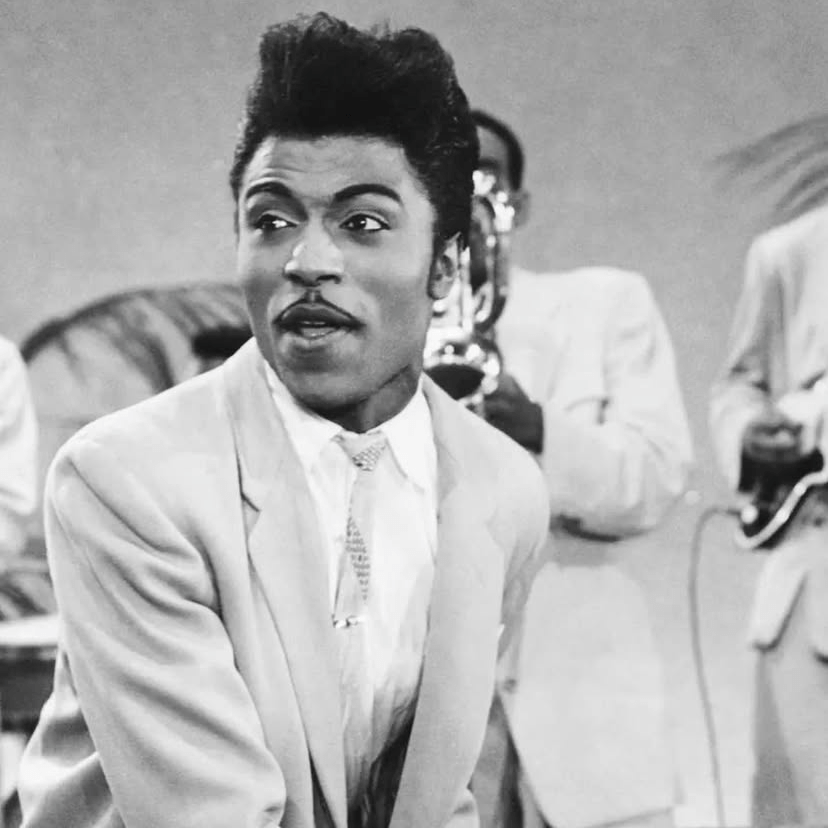
American singer-songwriter Richard Wayne Penniman, better known by his stage name Little Richard, was BOTD in 1932. Born in Macon, Georgia, he began performing at his family’s Pentecostal Christian church, studying musical in high school. Mocked for his diminutive build and effeminate appearance, he was thrown out of home by his father for suspected homosexuality. He joined the touring musical circuit, performing in minstrel bands and in drag as Princess LaVonne in gay nightclubs. Setting in Atlanta, he met fellow singer Billy Wright, who encouraged him to develop his signature look of a pompadour, a pencil moustache, pancake makeup and flamboyant clothes. He became an international star with his 1955 hit song Tutti Frutti, a rousing jazz and blues-based tune that laid the foundation for rock and roll, followed by Long Tall Sally. Famed for his showmanship, virtuoso piano playing and energetic high-pitched vocals, he became one of the first crossover Black artists, attracting a multi-racial fan base, and was one of the first American singers to perform in front of desegregated audiences. His work inspired a generation of rock and roll artists, including Elvis Presley, Buddy Holly, Bill Haley, Jerry Lee Lewis, the Everly Brothers and The Beatles, who took lessons from him in performance and vocalisation. His personal life was turbulent, affected by drug and alcohol addiction, affairs with men and women, a love of voyeurism and group sex, and a number of arrests for homosexual misconduct. In 1957 he became a born-again Christian and married Ernestine Harvin, separating in 1964 at the height of his drugs and gay orgies period. Later in life, he gave a number of interviews claiming to have been cured of being gay by by God and condemning homosexuality as a perversion. After years of ill health, he died in 2020, aged 87. His music and super camp aesthetic has influenced contemporary performers including Prince, Lenny Kravitz, Mick Jagger and Janelle Monáe.
Little Richard

 Super Gays Born on this Day