
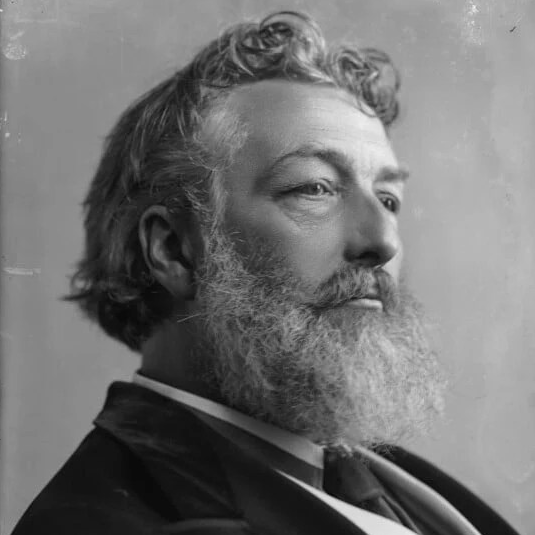
English artist Frederic Leighton, latterly Lord Leighton, was BOTD in 1830. Born in Scarborough to an upper middle-class family, he was educated at University College School in London, and studied art in Frankfurt and Florence. In 1855 he moved to Paris where he met the stars of mid-19th century painting including Jean Auguste Ingres, Eugène Delacroix, Jean-Baptiste-Camille Corot and Jean-François Millet. He returned to London in 1860, where he became one of the leading figures in the Pre-Raphaelite movement, working primarily in painting and sculpture. His notable works include the painting Flaming June, his celebrated bronze sculpture Athlete Wrestling with a Python, and designed the tomb of Elizabeth Barrett Browning in Florence. One of the most celebrated artists of his age, he became the President of the Royal Academy of Arts and represented Britain at the 1900 Paris Exhibition. Knighted in 1878, he was given a peerage in 1896 and created Baron Leighton, but died the following day, aged 65. A lifelong bachelor, Leighton’s sexuality has been the subject of extensive speculation. He had an intense, romantically coloured relationship with the poet Henry William Greville, who wrote him several love letters. Art historians and biographers have also pointed to Leighton’s love of painting the Queen’s Guards, the blatant homoeroticism of much of his work, and his extensive travels in Egypt, Algeria and Morocco, where homosexuality was decriminalised.
Frederic Leighton

 Super Gays Born on this Day