
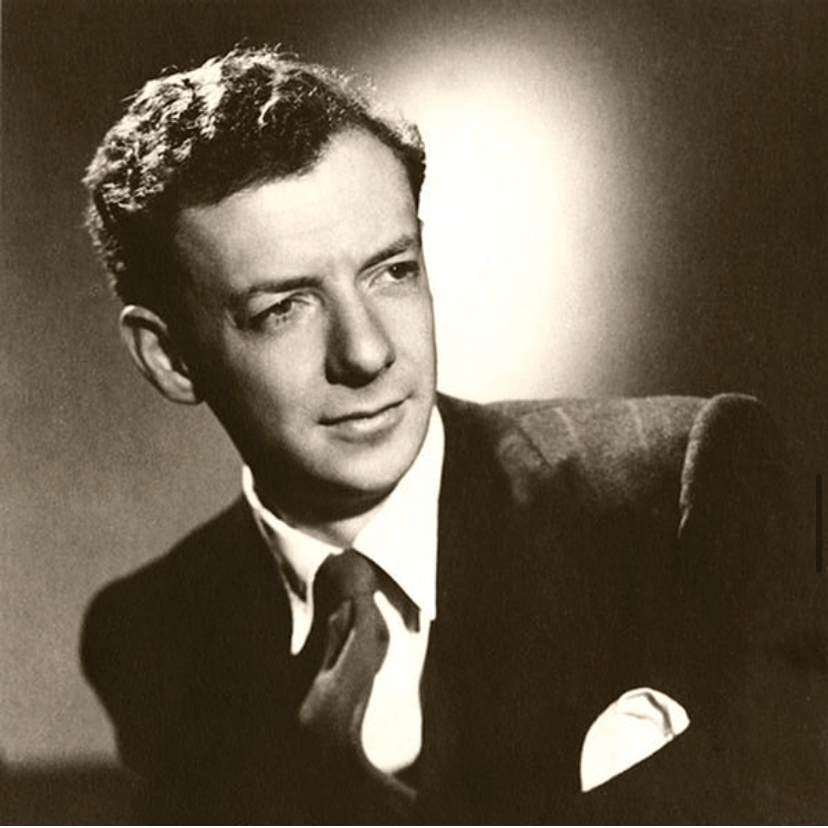
English composer and conductor Benjamin Britten was BOTD in 1913. Born in Lowestoft, Suffolk, he showed an early talent for music, studying performance and composition with composer Frank Bridges before moving to London to attend the Royal College of Music. He came to public attention with the 1934 choral work A Boy was Born, and later worked for the BBC’s film unit, collaborating on the short films Night Mail and The King’s Stamp with poet W. H. Auden. The openly gay and cheerfully promiscuous Auden encouraged the closeted Britten to accept his homosexuality. In 1937, Britten met the tenor Peter Pears, with whom he formed a lifelong personal and professional relationship. At the outbreak of World War Two, they moved to New York, living briefly at February House in Brooklyn, a queer artistic commune with housemates Gypsy Rose Lee, Carson McCullers, Christopher Isherwood, Paul and Jane Bowles, Lincoln Kirstein and Leonard Bernstein. Unimpressed with bohemian life, they returned to England in 1942. Britten vaulted to international celebrity with his 1945 opera Peter Grimes, a sombre drama about a fisherman who is rejected by his conservative community. A critical and commercial success, it was notable for Britten’s hypnotic evocation of the sea, and the queer coding of Grimes, who may have abused boys in his care. Britten returned to themes of closeted homosexual desire in his opera Billy Budd, based on Herman Melville‘s novella about a sea captain who persecutes a beautiful young naval recruit, and Death in Venice, an adaptation of Thomas Mann‘s novel about a middle-aged writer who becomes fatally obsessed with a pubescent boy. Britten wrote leading roles for Pears in all three pieces, showcasing Pears’ unusually high vocal range and making him an international opera star. His 1945 composition The Young Person’s Guide to the Orchestra, a light-hearted survey of the sections of an orchestra, became one of his most popular pieces. In 1947, Britten and Pears established a music festival at Aldeburgh in Britten’s childhood home in Suffolk. Their relationship was relatively open and accepted, even during the virulently homophobic 1950s. Less well-known were Britten’s sexually-charged friendships with pre-pubescent boys, notably the actor David Hemmings, who met Britten as a child and starred in his opera The Turn of the Screw, based on Henry James‘ short story. Britten and Pears remained together until Britten’s death in 1976 aged 63. After his death, Pears received a condolence letter from Queen Elizabeth II, thought to be the first Royal acknowledgment of a same-sex relationship. In his 2006 biography Britten’s Boys, John Bridcut chronicled Britten’s attraction to pre-pubescent boys, with whom he frequently shared his bed and bath, and at least one case of alleged sexual assault of a 13 year-old. The revelations prompted a critical re-evaluation of Britten’s legacy, suggesting strong autobiographical links with the anguished pederasts in his operas.
Benjamin Britten

 Super Gays Born on this Day