
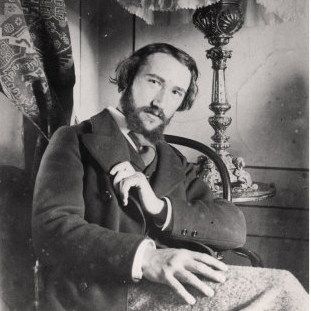
French writer André Gide was BOTD in 1869. Born in Paris to a bourgeois family, he was raised in Normandy. He published his first novel Les cahiers d’André Walter (The Notebooks of André Walter) in 1891, adopting the confessional format which would inform much of his future writing. In 1893 he made his first visit to French-ruled Algeria, befriending fellow sex tourists Oscar Wilde and Lord Alfred Douglas, who encouraged him to explore his homosexuality. Recalled to France because of his mother’s illness, Gide attempted a respectable bourgeois life, marrying his cousin Madeleine Rondeaux and becoming mayor of a commune in Normandy. The marriage was apparently sexless, though they remained married until her death in 1938. His internal conflicts between self-control and individualism were explored in his best known work, the 1902 novella L’immoraliste (The Immoralist), exploring a man’s desire for a young Algerian boy. Life eventually imitated art when he fell in love with his 15 year-old student Marc Allégret, scandalously eloping with him to London in 1918. Allégret later fell in love with Élisabeth van Rysselberghe, with whom he attempted unsuccessfully to have a child. Gide subsequently had a one-night stand with van Rysselberghe (by his account, his sole sexual experience with a woman) who subsequently gave birth to his daughter. The 1924 publication of Corydon, a Socratic defence of homosexuality and pederasty, was hugely controversial, leading to his being condemned by even his closest friends. The following year, he travelled to French Equatorial Africa, later publishing a harsh critique of French colonial policies and the exploitation of indigenous peoples. During the 1930s he embraced Communism, rejecting his beliefs after visiting the Soviet Union and witnessing the brutal censorship of the Stalinist era. In 1947, he was awarded the Nobel Prize for Literature for his “comprehensive and artistically significant writings, in which human problems and conditions have been presented with a fearless love of truth and keen psychological insight.” He devoted his final years to publishing his journals, covering 50 years of his life and providing some of the frankest discussions of his sexuality. He died in 1951, aged 81. One of the most revered writers of the 20th century, he was a major influence on Existentialist writers Jean-Paul Sartre, Albert Camus and Paul Bowles. His literary reputation as “France’s greatest contemporary man of letters” has been critiqued in recent years due to his stance on pederasty.
André Gide

 Super Gays Born on this Day