
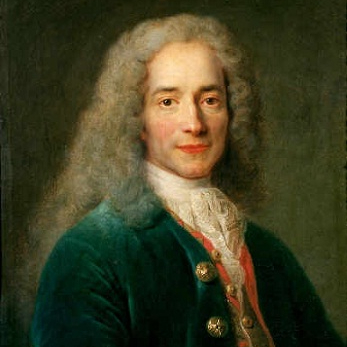
French writer and philosopher François-Marie Arouet, better known by his pseudonym Voltaire, was BOTD in 1694. Born in Paris to the minor nobility, he was educated at the Jesuit college of Louis-le-Grand, becoming fluent in many languages. He became a lawyer to please his father while secretly pursuing a career as a poet and writer. His written critiques of the government, nobility and the church frequently landed him in trouble, including an 11-month jail sentence for accusing Philippe, duc d’Orléans of committing incest. He established his literary reputation with his 1717 play Œdipe (Oedipus), which was a success in France and England. An astonishingly prolific writer, he became one of the central figure of the Enlightenment, producing plays, poetry, novels, essays, histories and scientific tracts, and writing over 20,000 letters. His writing wittily critiqued intolerance, religion and the civic institutions, culminating in his best-known work, the 1759 satire Candide, ou l’Optimisme (Candide, or Optimism). An outspoken advocate of civil liberties, he argued that sodomy “when not accompanied by violence” should not be a criminal offence. Publicly, he encouraged tolerance of non-European cultures and criticised slavery, while also investing in colonial enterprises that profiteered from the slave trade. He corresponded with some of the leading figures of the 18th century, including Jean-Jacques Rousseau, Russian Empress Catherine the Great and Prussian King Friedrich the Great. Voltaire never married, though had a 12-year affair with Émilie du Châtelet, a married mother of three. In later life, he lived with his niece Marie-Louise Mignot, who may have also been his lover. Biographers and historians continue to debate his sexuality. In her entertaining 1957 biography Voltaire in Love, Nancy Mitford wrote “nobody who studies the life of Voltaire can doubt that he had homosexual tendencies, and one wonders whether his feelings for [Frederick the Great] were not exacerbated by unrequited passion.” Candide was successfully adapted into a 1956 operetta by Leonard Bernstein.
Voltaire

 Super Gays Born on this Day