
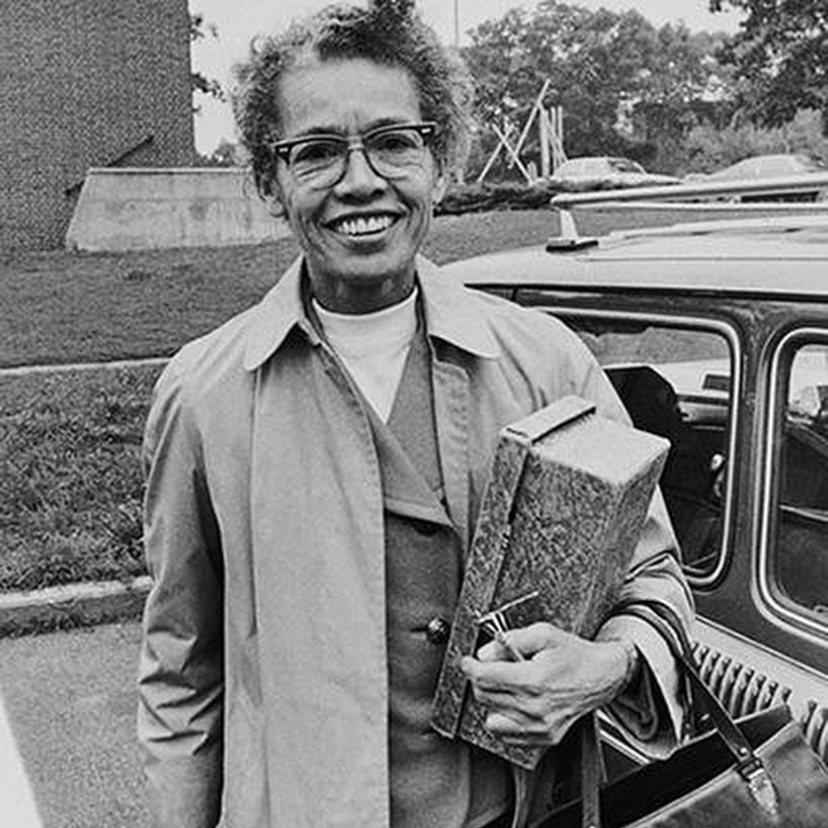
American activist, writer and cleric Pauli Murray was BOTD in 1910. Born Anna Pauline Murray in Baltimore, Maryland, she was orphaned in early childhood and raised by relatives in North Carolina. She studied at Hunter College, but was rejected from postgraduate studies at the University of North Carolina because of her race, a decision that received widespread press attention. In 1940, she was arrested in Virginia for sitting in the whites-only section of a public bus, again drawing press attention, and campaigned in support of a Black prisoner on Death Row. In 1941, she studied law at Howard University, the only woman in her class. After graduation, she worked for the California district attorney’s office and the law firm Paul Weiss, where she met and worked with lawyer-activist Ruth Bader Ginsberg. She became a central figure in the civil rights movement, coining the term “Jane Crow” to explain how segregation negatively affected African-American women. Her 1950 book States’ Laws on Race and Color was called “the Bible of the civil rights movement”, influencing the Supreme Court’s ruling in Brown v Board of Education to desegregate public schools. Her 1964 memorandum in support of adding gender as a protected category in the Civil Rights Act became similarly influential, and was quoted by Ginsberg in her brief for Reed v Reed, which extended Constitutional equal rights protection to women. She was ordained as an Episcopalian priest in 1977, working in the church until her death in 1985 aged 74. Murray struggled with her gender identity for much of her life, calling herself “Pauli” from her early 20s, dressing in men’s clothes and keeping her hair cropped short. After a brief, unsuccessful marriage in her youth, her romantic relationships were with women, notably Irene Barlow, with whom she lived for 20 years. Biographers have retrospectively classified Murray as transgender.
Pauli Murray

 Super Gays Born on this Day