
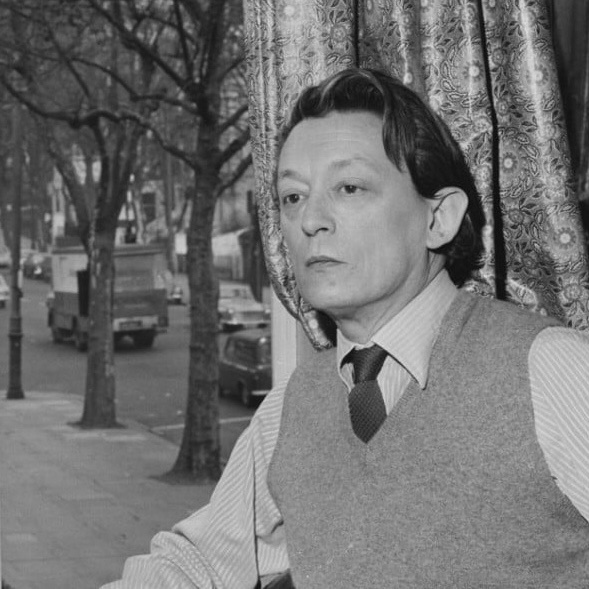
English writer and historian James Pope-Hennessy was BOTD in 1916. Born in London to an Irish military family, he and his elder brother John were educated at private schools and studied at Oxford University. He left in 1937 without completing his degree, and moved to London, working for a Catholic publishing house and socialising with celebrity homosexuals Harold Nicholson, Raymond Mortimer, Cecil Beaton and James Lees-Milne, with whom he had an on-off affair. His debut novel London Fabric won him the Hawthornden Prize, bringing him a modest degree of literary fame. In 1938, his mother arranged for him to become public secretary to Hubert Young, the Governor of Trinidad, experiences that inspired his 1943 book West Indian Summer. He returned to England at the outbreak of World War Two, enlisting in the British Army. Transferred to military intelligence, he was posted to Washington, D.C. Returning to London after the war, he shared a flat with fellow intelligence officer and notorious homosexual Guy Burgess, who was later revealed as a Soviet spy. In 1947, he became literary editor of The Spectator, before moving to France. He became better known in later life for his biographies of Baron Houghton, the Earl of Crewe, Queen Mary of Teck, his grandfather John Pope Hennessy, and the writers Anthony Trollope and Robert Louis Stevenson. Despite commercial success, he lived beyond his means, relying on his brother and friends for financial aid. After declaring bankruptcy in 1964, he moved to West Germany to live more cheaply. He returned to London in the 1970s to work on a biography of gay actor-writer Noël Coward. Cheerfully and openly promiscuous, he frequented backstreet bars in London, hunting for rough trade. In 1974, he was brutally assaulted by three young men he had invited back to his flat, dying after choking on his own blood from a lip wound. He was 57. His killers were convicted of manslaughter, though their sentences were reduced on appeal.
James Pope-Hennessy

 Super Gays Born on this Day