
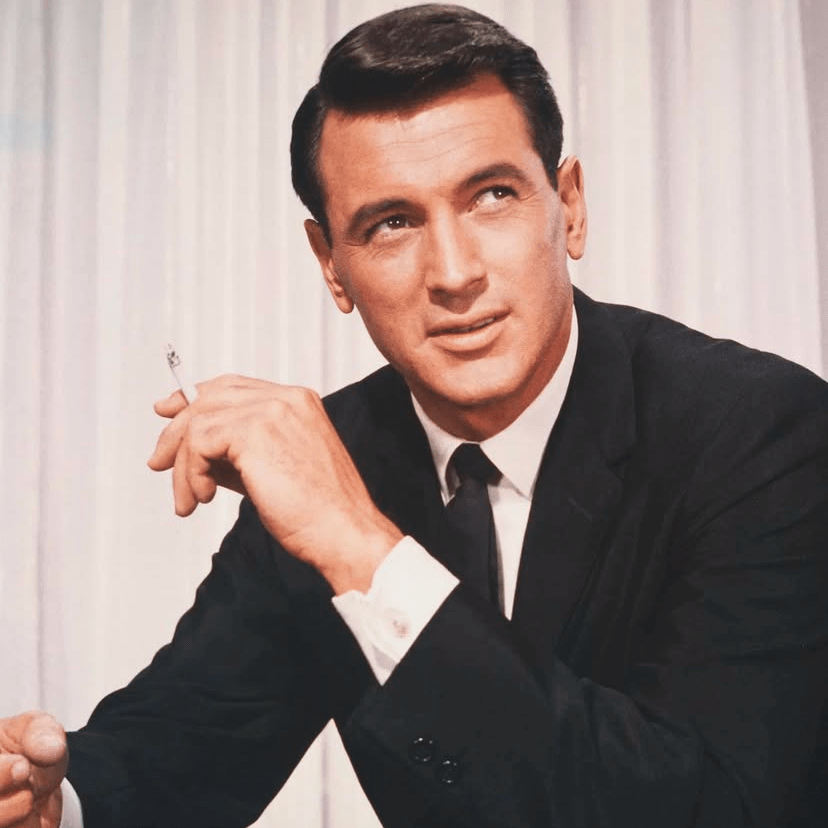
American actor Rock Hudson was BOTD in 1925. Born Roy Scherer in Winnetka, Illinois to working-class parents, his father abandoned the family when he was a child, and he was raised by his mother and stepfather. After finishing high school, he enlisted in the US Navy, and was posted to the Philippines during World War Two. After the war, he moved to Los Angeles to pursue a career in acting, working as a truck driver to support himself. He was discovered by predatory gay talent agent Henry Willson, who changed his name to Rock Hudson, hustling him into a small role in the 1984 war film Fighter Squadron. Signed by Universal Pictures, he received extensive acting and movement coaching, and was groomed as a photogenic matinée idol. After a series of supporting roles in B-movies, he became a leading man in 1952’s Scarlet Angel, and made a splash in Douglas Sirk’s Has Anybody Seen My Gal? His stardom soared in the 1950s as the leading man in Sirk’s melodramas Magnificent Obsession, All That Heaven Allows and Written on the Wind, embodying an artificial but hugely desirable ideal of rugged American masculinity. He also had huge success in Giant, opposite James Dean and Elizabeth Taylor, earning his first Oscar nomination. In the 1960s, he transitioned to lighter romantic comedies, paired successfully with Doris Day in Pillow Talk (in which his character poses as gay to lure Day into bed), Lover Come Back and Send Me No Flowers. As his film career faded, he transitioned into television in the 1970s, having a huge hit with the sitcom McMillan & Wife. Hudson’s homosexuality was an open secret in Hollywood, carefully hidden by Willson and a brief stage-managed wedding to Phyllis Gates. His many lovers included actor Burt Lancaster, Hollywood hustler Scott Bowers and the novelist Armistead Maupin, who fictionalised their affair in his Tales of the City novel series. In 1984, Hudson had a recurring role in TV soap opera Dynasty, though his rapidly deteriorating health made it impossible for him to continue. Diagnosed with AIDS in 1984, he kept his illness secret while travelling to France for experimental treatment. In 1985, he appeared in a press conference with Doris Day, shocking audiences with his gaunt appearance. He publicly confirmed his illness a few days before his death, aged 59. His death prompted a radical re-evaluation of his life and work, significantly raising public awareness of the HIV/AIDS epidemic. Within a week of his death, the Reagan administration (which had been appallingly indifferent to AIDS for most of the 1980s) established a federal fund for AIDS research. Hudson’s status as a closeted gay man in Hollywood was fascinatingly explored in Mark Rappaport‘s 1992 documentary Rock Hudson’s Home Movies, viewing his homosexuality through clips from his films. He was portrayed by Thomas Ian Griffith in a 1990 TV biopic, based on Gates’ memoir about their marriage, and more recently by Jack Picking in Ryan Murphy‘s 2020 TV drama series Hollywood.
Rock Hudson

 Super Gays Born on this Day