
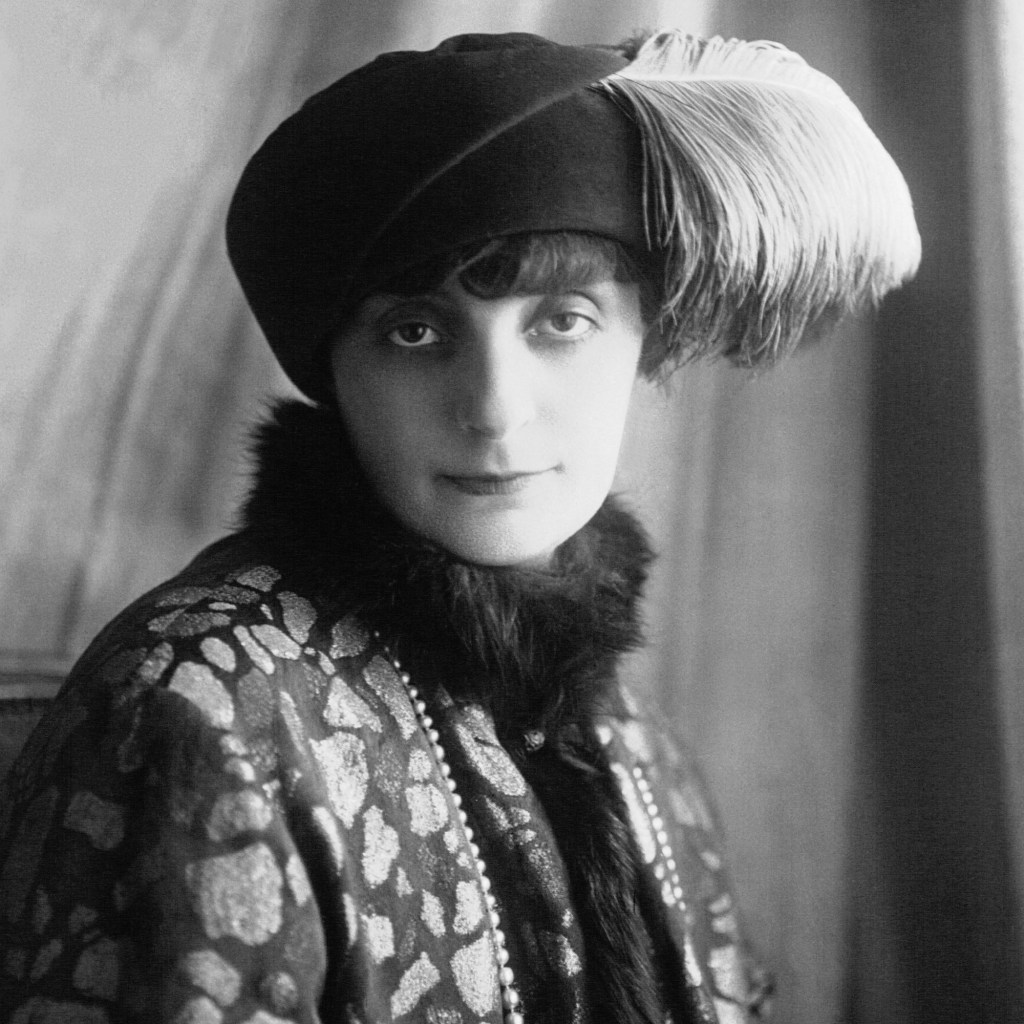
French-Romanian aristocrat, writer and socialite Anna de Noailles was BOTD in 1876. Born in Paris, the daughter of exiled Romanian Prince Grégoire Bibesco-Bassaraba, she was christened Anna Elisabeth Bibesco-Bassaraba de Brancovan, styled but seldom using the title of Princess. Despite a luxurious childhood, her early life was marked by her father’s death when she was nine and frequent illnesses. Privately tutored, she became fluent in English, German, Romanian and Greek and developed an early interest in literature. In 1897, she married Mathieu de Noailles, the youngest son of the 7th duc de Noailles, with whom she had a son. Tthey became the stars of Parisian high society, hosting a literary salon with celebrity guests including her childhood friend Marcel Proust, Colette, André Gide, Robert de Montesquiou, Rainer Maria Rilke, Paul Valéry, Jean Cocteau, Edith Wharton, Max Jacob and François Mauriac. Considered one of the leading beauties of her generation, she sat for portraits by painters Antonio de la Gándara, Paul Thévenaz, Jacques Émile Blanche, Jean de Gaigneron and Philip de László and the sculptor Auguste Rodin. In 1901, she published her first poetry collection Le Coeur innombrable (The Numberless Heart), prompting Proust to host a banquet in her honour, with readings of her work by theatre star Sarah Bernhardt. Her debut novel Le Visage émerveillé (The Face of Amazement) followed in 1904. She went on to publish ten further volumes of poetry two novels and five collections of essays and criticism, some of which became bestsellers, earning praise from French and international critics. She also created the Vie Heureuse (now the Prix Femina), the only French literary prize awarded by an all-female jury. Her relationship with Mathieu was unhappy, and she pursued affairs with writers Henri Franck and Charles Demange, prompting a scandal after Demange killed himself and named her in his suicide note. A friend of lesbian society hostess Natalie Clifford Barney, she attended many of Barney’s women-only salons, and is thought to have had affairs with women, a subject alluded to in her novels and poetry. In 1921, she was awarded the Grand Prix of the Académie Française, and in 1931 became the first woman to be appointed a Commander of the Legionne d’honneur. She died in 1933, aged 56, and was given a state funeral, buried in her family vault in Père Lachaise Cemetery.
Anna de Noailles

 Super Gays Born on this Day