
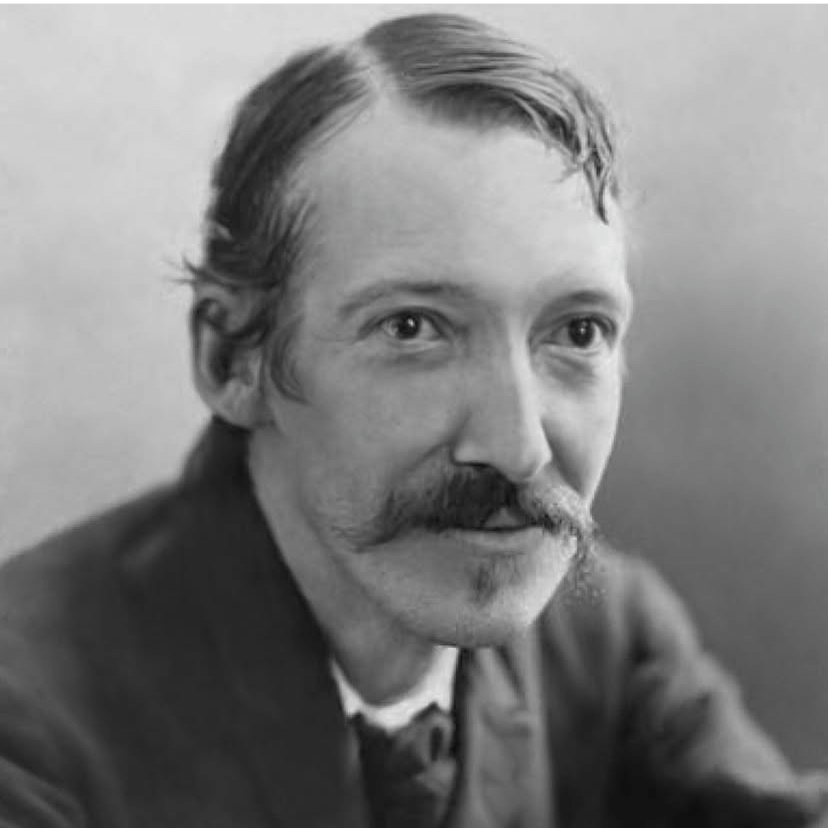
Scottish writer Robert Louis Stevenson was BOTD in 1850. Born in Edinburgh to a middle-class family with aristocratic connections, he was educated by private tutors due to his frequent illnesses, and wrote compulsively from early childhood. He eventually rejected his upbringing, dressing as a Bohemian and renouncing religion (while still relying on his family for money). At his family’s insistence he qualified as a lawyer, but never practised, instead moving to London where he consorted with writers, homosexuals and prostitutes. In 1877, he married Frances (Fanny) van de Grift Osbourne, travelling extensively to warmer climates for his health. They settled in Dorset for three years, where Stevenson wrote the children’s adventure stories Treasure Island and Kidnapped and the poetry collection A Child’s Garden of Verses. He is best known for his 1886 novella Strange Case of Dr Jekyll and Mr Hyde, a Gothic tale of a respectable Victorian doctor who transforms himself into an evil alter-ego, committing a series of murders that terrorise Victorian London. He became a literary celebrity, with admirers including writer Henry James and painter Paul Gauguin, and had a passionate, erotically-charged correspondence with J. M. Barrie (who wrote to him “To be blunt I have discovered (have suspected it for some time) that I love you, and if you had been a woman…”). After travelling in the South Pacific, Stevenson settled in Samoa, where he encouraged local chiefs to defend their communities from imperialism. He died in Samoa in 1894, aged 44. While Stevenson’s relationships were with women, he mixed freely within a homosexual milieu, and was both aware of and amused by his attractiveness to men. His friend Andrew Lang, who was gay, said that Stevenson “possessed, more than any man I ever met, the power of making other men fall in love with him.” Jekyll and Hyde has become one of the world’s most popular dramatic narratives, with famous stage and film performances by John Barrymore, Fredric March, Spencer Tracy, Kirk Douglas, Michael Caine, Anthony Perkins and John Malkovich. Stephenson’s book has also been interpreted as a metaphor for homosexuality as a secret and criminal double identity, with Mr Hyde as the expression of Jekyll’s repressed sexual desires.
Robert Louis Stevenson

 Super Gays Born on this Day