
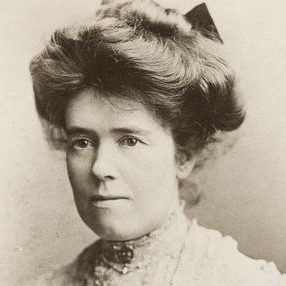
Welsh suffragette and editor Rachel Barrett was BOTD in 1874. Born in Carmarthen to a working-class family, she was educated at a boarding school in Stroud, winning a scholarship to the University College of Wales in Aberystwyth. After graduating in 1904, she worked as a science teacher. In 1906, she attended a women’s suffrage rally in Cardiff, and immediately joined the Women’s Social and Political Union, helping organise rallies and meetings in Cardiff alongside Adela Pankhurst, and frequently making speeches in Welsh. After being flour-bombed at a rally, the resulting press attention drew the disapproval of her school. She resigned in 1907, moving to London to study at the London School of Economics, and became a central figure in the WSPU’s London branch, working alongside Emmeline and Christabel Pankhurst and befriending American activist Alice Paul. The following year, she left her studies to become a full-time organiser for the movement, organising campaigns and rallies in London, Nottingham, Dundee, Bristol and Newport. In 1910, she led a meeting with the then-Chancellor of the Exchequer David Lloyd George to (unsuccessfully) win his support for voting rights. After a period of ill health, returned to Cardiff to lead WSPU activities across Wales, returning to London in 1912 where she became the editor of the WSPU’s newspaper The Suffragette. Despite having no prior experience, she became a committed editor, keeping the newspaper running despite Government attempts to suppress it and travelling regularly to Paris to visit the Pankhursts in exile. She also formed a relationship with the Australian writer Ida (I.A.R.) Wylie, becoming life partners. In 1913, Barrett and others were arrested on changes of conspiring to damage criminal property, and she was imprisoned for nine months, undergoing repeated hunger strikes. She eventually escaped to Scotland, living in hiding with Wylie in Edinburgh. At the outbreak of World War One, Barrett supported Emmeline’s policy to suspend the suffrage campaign and join the war effort. In 1918, Lloyd George’s government extended voting rights to property-owning women over the age of 30. Barrett and Wylie subsequently moved to the United States, travelling through the country for a year and settling in California. They returned to England in the 1920s, continuing to advocate for universal suffrage for women, which was eventually granted in 1928. Later that year, Barrett campaigned for funds for a statue of Emmeline near the Parliament buildings. She and Wylie also befriended celebrity lesbian couple Radclyffe Hall and Una Vincenzo, supporting Hall during the obscenity trial over her novel The Well of Loneliness. She later worked for the Equal Political Rights Campaign Committee, wrote an unpublished memoir of fellow suffragette Kitty Marshall and joined her local Women’s Institute. Barrett remained with Wylie until her death in 1953, aged 78.
Rachel Barrett

 Super Gays Born on this Day