
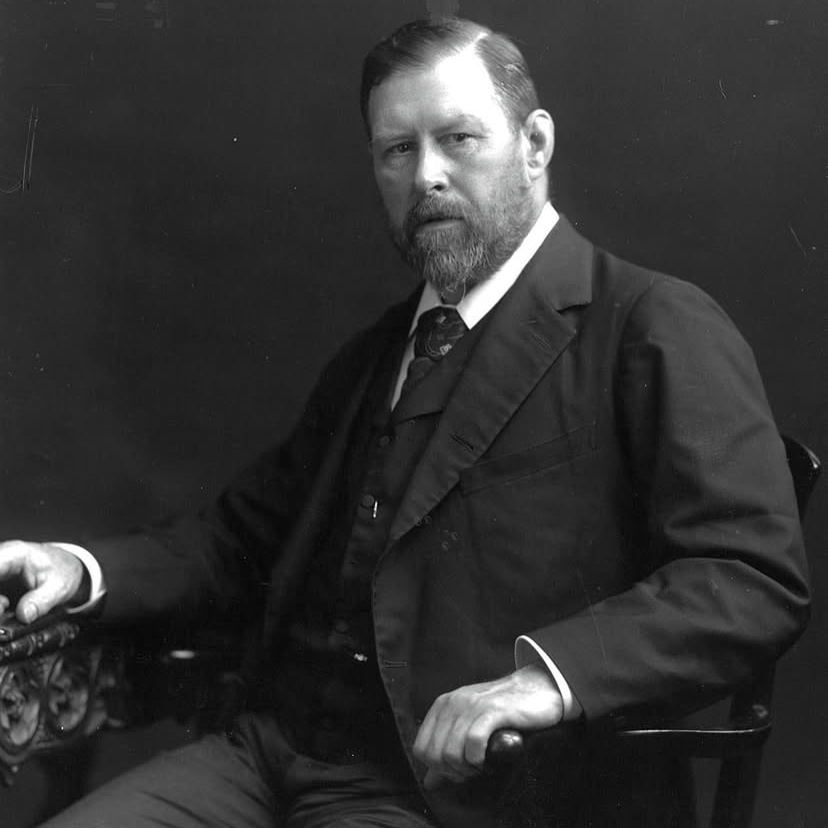
Irish writer Bram Stoker was BOTD in 1847. Born in Dublin, he studied at Oxford University, where he befriended notorious homosexual Oscar Wilde. After graduation, he joined the Irish civil service, becoming a part-time theatre critic. In 1878, he married Wilde’s former love interest Constance Balcolme, with whom he had a son. The following year he moved to London to work for theatre star Henry Irving, mixing in fashionable London society and accompanying Irving on acting tours through Europe and America. While his marriage appears to have been sexless, Stoker had a series of passionate, erotically-charged friendships with men, particularly with the writer Hall Caine (whom biographers have speculated was also his lover) and the poet Walt Whitman, to whom he wrote a gushing fan letter about Leaves of Grass. He is best known for his 1897 novel Dracula, a Gothic horror story about a Transylvanian vampire who terrorises England, drinking the blood of his victims and turning women into nymphomaniacs. In his later years, Stoker became increasingly puritanical, publicly condemning homosexuality while privately visiting Wilde after his release from prison. He died in 1912, possibly of tertiary syphilis, aged 64. Now one of the most famous books in the world, Dracula has been filmed endlessly, popularising vampires in the cultural imagination. Notable film adaptations include F. W. Murnau’s 1922 silent film Nosferatu, remade in 1979 by Werner Herzog and in 2023 by Robert Eggers; Tod Browning’s 1932 Hollywood film Dracula starring Bela Lugosi; a popular 1960s film series produced by Hammer Studios and starring Christopher Lee; the Andy Warhol-produced 1974 pastiche Blood for Dracula, directed by Paul Morrissey and starring Udo Kier and Joe Dallesandro; and Francis Ford Coppola’s lavish 1992 film Bram Stoker’s Dracula, drawing on the story of Vlad the Impaler, the supposed inspiration for Stoker’s story. Literary critics and queer studies scholars have noted the intense homoerotic charge of Stoker’s text, arguably reflecting the author’s suppressed homosexuality.
Bram Stoker

 Super Gays Born on this Day