
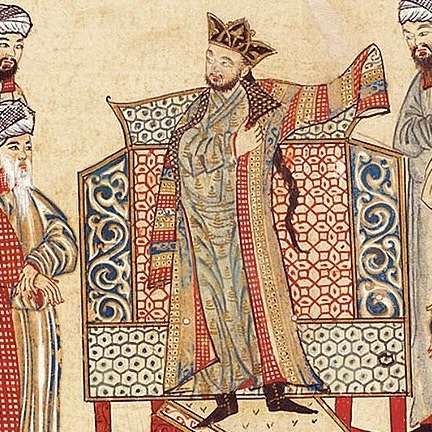
Persian monarch and military commander Maḥmūd of Ghazni, also known as Yamin al-Dawla, was BOTD in 971. Born in Ghazni, Zabulistan (in present-day Afghanistan), his father Sebüktigin was a former slave who in 977 became ruler of Ghazna and established the Ghaznavid dynasty. Maḥmūd was raised with his foster brother Ahmad Maymandi, and took a prominent part in his father’s military campaigns in his teens. In 998, aged 27, his younger brother Ismail succeeded to the throne, but was quickly deposed by Maḥmūd, who became the first ruler to hold the title of Sultan. Aspiring to be a great monarch, he led a series of successful military campaigns to expand his kingdom, eventually annexing the Punjab in the Indian sub-continent, and into present-day Iran, Pakistan and Afghanistan. Rich from the wealth of his conquered Indian territories, he transformed Ghazna into a centre of art and culture, establishing educational institutions and building mosques, palaces and gardens, and became a patron to mathematicians, philosophers, historians and poets. A devotee of the Shafi’i school of Islamic law, he operated a zero-tolerance policy towards religious heretics, capturing, imprisoning and torturing dissident religious sects. Maḥmūd had ten children with two wives, and also kept a male companion Malik Ayāz, a freed Georgian slave whom eventually became general of Maḥmūd’s army and the first Viceroy of Lahore. He died of tuberculosis in 1030, aged 58, briefly succeeded by his son Muhammad, who was overthrown by Muhammad’s twin brother Ma’sud.
Maḥmūd of Ghazni

 Super Gays Born on this Day