
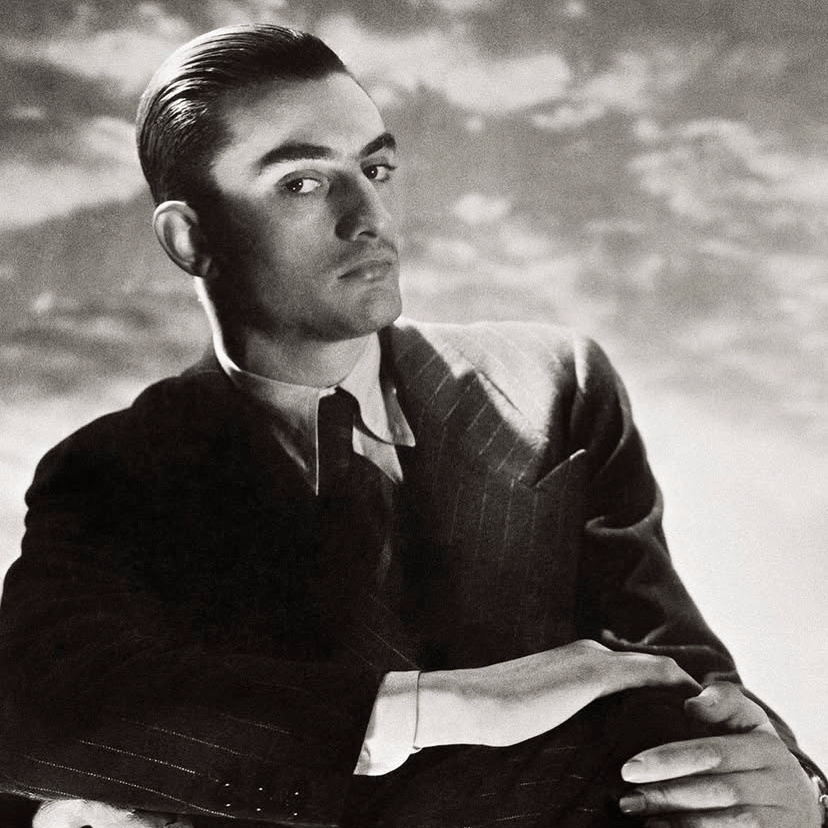
Italian filmmaker Luchino Visconti was BOTD in 1906. Born in Milan to an aristocratic family, he grew up in the Palazzo Visconti di Modrone, receiving a classical education and interacting with family friends including composer Giacomo Puccini, conductor Arturo Toscanini and novelist Gabriele D’Annunzio. In 1935, the fashion designer Coco Chanel recommended him as an assistant to French filmmaker Jean Renoir, leading to work as a set decorator on Renoir’s Partie de campagne (A Day in the Country) and Tosca. During World War Two, he joined the Italian Communist Party, opposing Mussolini’s Fascist regime (despite his attraction to uniformed soldiers), helping hide escaped American and English prisoners-of-war. His 1943 debut feature film Obsessione (Obsession) was banned for its critique of Fascism. Detained by Nazi forces in 1944, he narrowly escaped execution due to the intervention of actress Maria Denis. After the war, he became a pioneer of the Italian neorealist movement with La terra trema (The Earth Trembles); Bellissima (The Most Beautiful) and Siamo donne (We the Women), both starring Anna Magnani; and the highly-praised Rocco e i suoi fratelli (Rocco and His Brothers), launching the career of Alain Delon. He rose to wider international attention with 1963’s Il gattopardo (The Leopard) a baroque drama about a declining Sicilian aristocratic dynasty, winning the Palme d’Or at the Cannes Festival. As a theatrical director, he introduced Italian audiences to the plays of Jean Cocteau, Jean-Paul Sartre, Arthur Miller and Tennessee Williams, and helped launch opera singer Maria Callas to fame with celebrated productions of La traviata, La sonnambula and Don Carlos. He scored another international hit with his 1969 film Götterdämmerung (The Damned), a lurid melodrama about a German industrialist family’s decline into fascism, starring Dirk Bogarde and Visconti’s lover Helmut Berger. The film’s depictions of homosexuality, pedophilia, rape and incest shocked and thrilled American audiences, earning the twin accolades of an X rating and an Oscar nomination for Visconti’s screenplay. He received further acclaim for his 1971 adaptation of Thomas Mann‘s novella Morte a Venezia (Death in Venice), starring Bogarde as a composer who becomes erotically fixated with a teenage boy. He completed his “German trilogy” with 1973’s Ludwig, starring Berger as the deranged queer monarch King Ludwig II of Bavaria. Openly gay since forever, Visconti had affairs with photographer Horst P. Horst, his directorial assistant Franco Zeffirelli, actor Udo Kier and (according to his memoir) King Umberto II of Italy. His relationship with Berger was fascinatingly explored in his 1974 film Gruppo di famiglia in un interno (Conversation Piece), in which Lancaster plays an elderly closeted aristocrat who becomes enamoured of a young man (played by Berger). Visconti died in 1976 aged 69. Now considered one of the 20th century’s greatest filmmakers, his work was highly influential on New Hollywood filmmakers including Francis Ford Coppola and Martin Scorsese.
Luchino Visconti

 Super Gays Born on this Day