
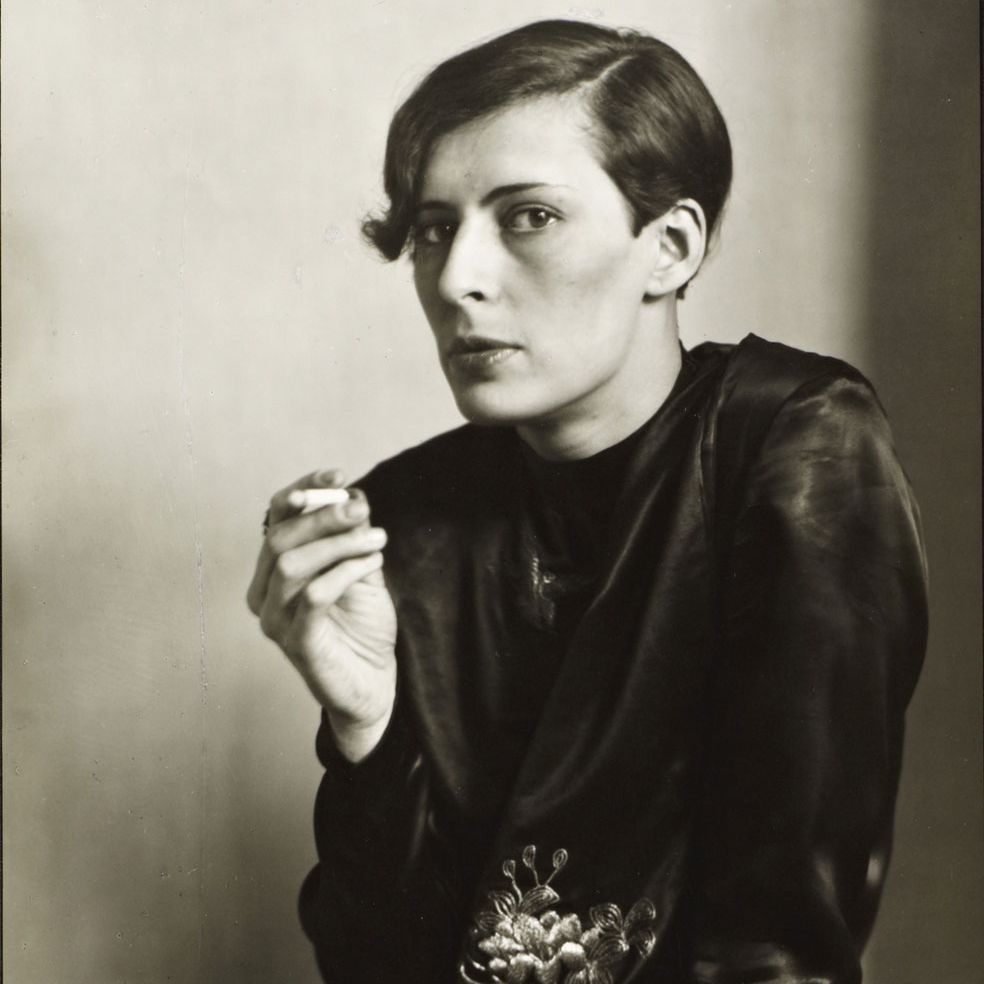
German artist Hannah Höch was BOTD in 1889. Born in Gotha, Thuringia in the Kingdom of Germany, she studied glass design at the School of Applied Arts in Berlin-Charlottenburg, until her studies were interrupted by World War One. She re-enrolled in 1915, studying painting, graphic design and woodcuts, and formed a relationship with Austrian artist Raoul Hausmann, who introduced her to the Dadaist arts movement. She began experimenting with collage and photo-montage, supporting herself via journalism and designing handicraft patterns. In 1920, she exhibited her work at the inaugural International Dada Fair, drawing praise for her large-scale photomontage Cut with the Kitchen Knife Through the Last Weimar Beer-Belly Cultural Epoch in Germany. Largely ignored and marginalised by all-male Dadaist circles, she separated from the movement (and Hausmann) in 1922, reinventing herself as a “New Woman”, cutting her hair short and seeking artistic and financial independence. She moved to The Hague in 1926, creating a scandal by living openly with her girlfriend, the feminist author Til Brugman. Her work became increasingly politicised, using images of dolls, mannequins and advertisements to subvert traditional images of women. The rise of the Nazi Party in 1934 resulted in her being blacklisted as a “cultural Bolshevist”, and she retreated to the village of Heiligensee in suburban Berlin, where she lived for the rest of her life. In 1938, she married the pianist Kurt Matthies, divorcing six years later. She re-emerged into the arts world after World War Two, branching into textile and pattern designs, and taking advantages of new developments in colour printing to colorise her early collage work. Her work was rediscovered in the 1970s by feminist scholars, prompting her best-known collage, the 1972 retrospective Lebensbild (Life Portrait). She died in 1978, aged 88.
Hannah Höch

 Super Gays Born on this Day