
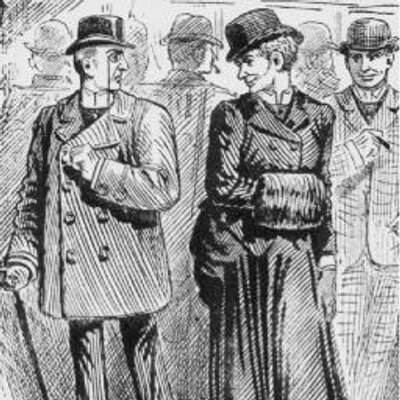
Irish sex worker Jack Saul was BOTD in 1857. Born Johannes Saul in Dublin, he grew up in poverty, and little is known of his early life. When he was 17, Saul met and had an affair with Martin Kirwan, a captain in the Royal Irish Fusiliers, and began attending sex parties hosted by civil servant Gustavus Cornwall at British government headquarters in Dublin Castle. Saul obtained a position as a manservant for prominent doctor Joseph Cranny, but was arrested in 1878 for theft from Cranny’s home. Described in police records as being “fair and blue-eyed with a fair complexion”, he was later acquitted, but lost his job. In 1879, he moved to London, supporting himself with sex work. In 1881, the pornographer William Lazenby published an erotic novel, The Sins of the Cities of the Plain; or, The Recollections of a Mary-Ann, with Short Essays on Sodomy and Tribadism, chronicling the sexually explicit adventures of a teenaged rent boy named Jack Saul, including taking part in a orgy with the cross-dressing actors Thomas Boulton and Frederick Park. Authorship of the book has since been attributed to Scottish pornographer James Campbell Reddie, though Reddie may have based his narrative on conversations with Saul. In 1884, Saul was recalled to Dublin to testify against Kirwin and other participants in the Dublin Castle orgies. Saul was never called to give evidence in court, probably due to his reputation as a known sex worker. Returning to London, he took up residence at a male brothel at 19 Cleveland Street, run by Charles Hammond. In 1889, the brothel was discovered by police and became a media scandal, prompting widespread speculation about the identities of Hammond’s high-ranking clients, including Lord Arthur Somerset, the friend and equerry of Prince Albert Victor. Later that year, the North London Press published a story naming Henry Fitzroy, Earl of Euston, as having visited the brothel. After Fitzroy sued the editor for libel, Saul was called as chief witness for the defence. Described as sharp, witty and defiant, Saul delivered his testimony with “brazen effrontery that reduced the court to shocked silence”, admitting to being a prostitute and describing his sexual encounters with Fitzroy in graphic detail. The trial judge encouraged the jury to disregard Saul (whom he described as a “loathsome object”) and Fitzroy won his libel suit, though historians are generally agreed that Saul’s testimony was correct. Despite his admitting to committing sodomy, Saul was never charged with sexual offences, likely due to police concerns that he would name Prince Albert Victor as a brothel attendee. After the trial, Saul became a servant in a London hotel, returning to Dublin in 1901 where he worked as a butler. He died of tuberculosis in 1904, aged 46. Gay historians including Morris Kaplan have hailed Saul as an heroic figure, who refused his status as an outcast in homophobic Victorian society.
Jack Saul

 Super Gays Born on this Day