
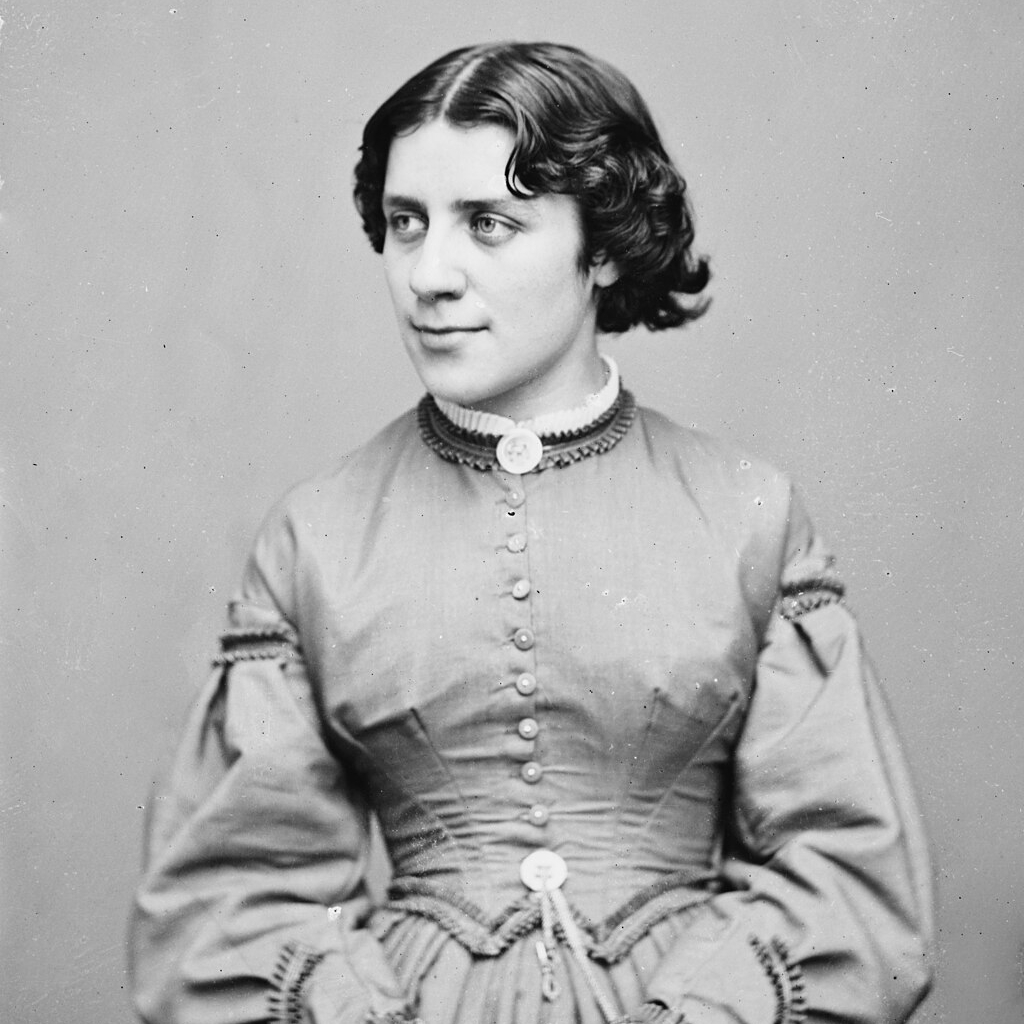
American journalist and activist Anna Dickinson was BOTD in 1842. Born in Philadelphia, Pennsylvania to a Quaker family, she began campaigning for the abolition of slavery in her early teens, publishing an essay in The Liberator about the abuse of an abolitionist schoolteacher in Kentucky. Leaving school at 15, she became one of the first female employees at the United States Mint, but was fired after criticising the poor performance of Unionist forces in the Civil War. She became a well-known public speaker, undertaking lecture tours on abolition, reconstruction, women’s rights and the temperance movement, and visiting hospitals and camps to speak to Union soldiers. During the 1863 Senate elections, she campaigned in support of the Radical Republicans’ anti-slavery agenda and the preservation of the Union, becoming known as the Civil War’s Joan of Arc. In 1864, she earned a standing ovation after a passionate address on the floor of the House of Representatives, and was the first woman invited to speak before Congress. Her many admirers included President Abraham Lincoln and the writer Mark Twain, who commented that she “has the most perfect confidence in herself” and praised “her vim, her energy, her determined look [and] her tremendous earnestness”. After calling President Grover Cleveland “the hangman of Buffalo” in an 1873 speech, she was dropped by the Republicans, and became a mountaineer, playwright and occasional actress. She suffered from mental illness later in life, and was committed to an asylum in 1891. On her release, she successfully sued newspapers who claimed she was insane and resumed lecturing, until poor health forced her to retire. She lived quietly with her friends George and Sally Ackley in upstate New York for another 40 years, dying in 1932 aged 89. Her correspondence, published posthumously, revealed her sexual relationships with Sally and another woman named Ida.
Anna Dickinson

 Super Gays Born on this Day