
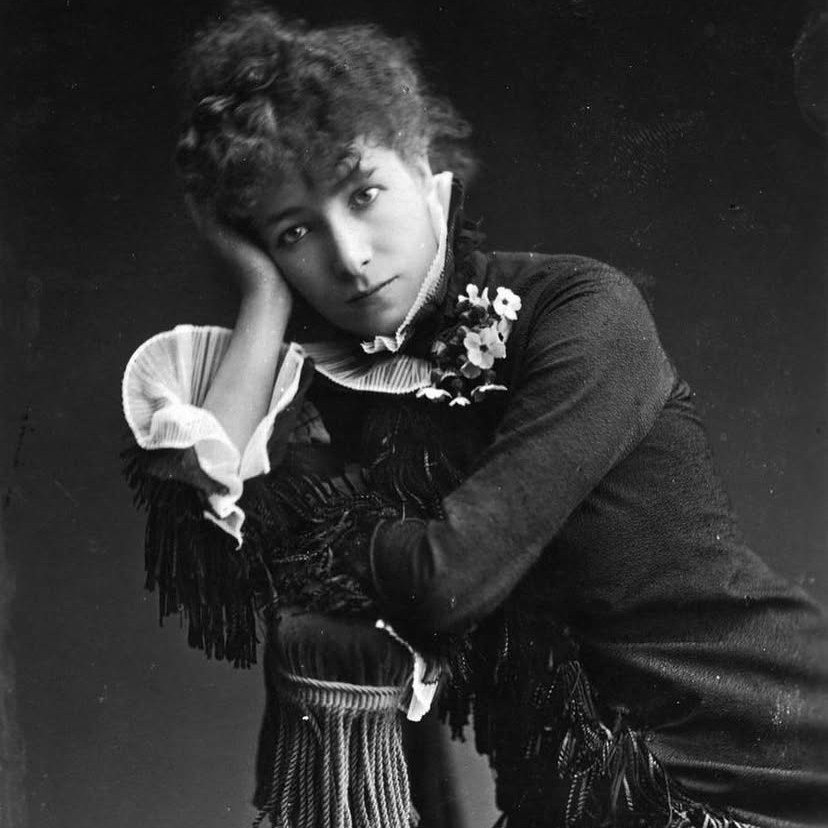
French actress and producer Sarah Bernhardt was BOTD in 1844. Born in Paris, the illegitimate daughter of a Dutch courtesan, she received a convent education, and was sponsored to attend the Conservatoire de Paris by her mother’s patron the duc de Morny. With the duke’s intervention, she joined the Comédie-Française, leaving after slapping the face of the company’s star Madame Nathalie. She found work with the Théâtre du Gymnase-Dramatique, and had an affair with the Belgian Prince Henri de Ligne, with whom she had a son. In 1866, she joined the Odéon theatre, scoring critical triumphs in a revival of Alexandre Dumas père‘s play Kean and François Coppée’s verse drama Le Passant (The Passerby). She became the greatest classical actress of her age, admired for her charismatic stage presence, sonorous voice and immaculate diction, and especially praised for her interpretations of Jean Racine’s Phèdre and the doomed courtesan of Alexandre Dumas fils‘ La Dame aux camélias (The Lady of the Camellias). Unusually for her time, she played a number of male roles, including a celebrated portrayal of Shakespeare’s Hamlet. As her popularity increased, she assumed complete control over her career, managing her own theatre, commissioning new works from the playwright Victorien Sardou, undertaking tours of England, Europe and the Americas, and engaging Art Nouveau artist Alphonse Mucha to paint her portraits. The Lumière Brothers filmed many of her performances, making her one of the world’s first filmed actresses. Equally as fearless offstage, she converted the Odèon theatre into a military hospital during the 1870 Siege of Paris, campaigned for the release of wrongfully convicted Jewish soldier Alfred Dreyfus, visited the Western Front during World War One, and continued to perform even after her leg was amputated in 1915. In her final years, she took up oil painting, and published her memoir Ma Double Vie, and L’Art du Théâtre (The Art of the Theatre), a textbook on acting. She had long-term affairs with a number of her leading men, including Lou Tellegen, a Dutch actor 37 years her junior, and discreet relationships with the writer Victor Hugo and Edward, Prince of Wales (later King Edward VII). Though no evidence exists of any affairs with women, she had close friendships with a number of gay writers, including George Sand, Colette, Oscar Wilde, Marcel Proust (who immortalised her as “La Berma” in his novel À la recherche du temps perdu) and Jean Cocteau, while her independence and disregard for gender norms added to her feminist and queer appeal. She died in 1923 aged 78. Still a legendary figure in France, she has been portrayed onscreen by Jeanette Nolan, Glenda Jackson, Ludmila Mikaël and Isabelle Huppert.
Sarah Bernhardt

 Super Gays Born on this Day