
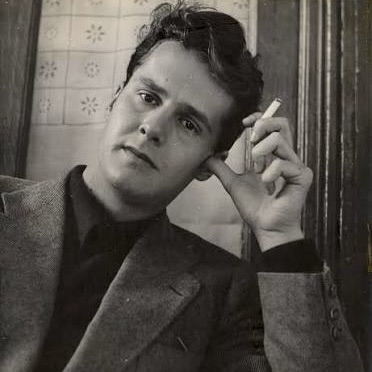
American composer and memoirist Ned Rorem was BOTD in 1923. Born in Richmond, Indiana, he was raised in Chicago, studying at Northwestern University before winning a scholarship to the Curtis Institute of Music in Philadelphia. As a student, he made regular visits to New York City, where he befriended (and slept with) the composers Leonard Bernstein, Aaron Copland and Virgil Thomson, eventually moving to the city to study at the Juilliard School. He moved to Paris in 1949, securing the friendship and patronage of Vicomtesse Marie-Laure de Noailles, who introduced him to her artistic circle, including Pablo Picasso, Alice B. Toklas, Salvador Dalí, Man Ray, Jean Cocteau and Francis Poulenc. He returned to New York in the early 1960s to take up a Guggenheim Fellowship, scoring further success with his 1963 song cycle Poems of Love and the Rain, adapting the poetry of Emily Dickinson, Donald Windham and Theodore Roethke, followed by War Scenes with text by Walt Whitman. He also composed orchestral pieces and operas, with mixed success. In 1966, he began a startling second career as a memoirist, publishing The Paris Diary of Ned Rorem, a confessional and gossipy chronicle of his Paris years, interspersing celebrity anecdotes with music criticism and graphic details of his hundreds of sexual liaisons. A New York diary followed the following year, outing many of his closeted celebrity lovers including Bernstein, Noël Coward, Tennessee Williams and John Cheever. In 1967, he began a relationship with the composer James Holmes, who became his life partner. In 1976, he won the Pulitzer Prize for Music for his Air Music suite, commissioned for the American bicentennial by the Cincinnati Symphony Orchestra. He retreated to Nantucket with Holmes, chronicling their domestic life and (apparently happy) monogamous relationship in The Nantucket Diary of Ned Rorem, 1973-85. In 1998, aged 74, he attended the premiere of his concert-length song cycle Evidence of Things Not Seen, featuring poems by 24 writers including Whitman, Oscar Wilde, A. E. Housman, Colette, W. H. Auden, Langston Hughes and Edna St. Vincent Millay. Its final section, a memorial to his friends who died from HIV/AIDS, featured the work of gay poets Paul Monette, Stephen Crane and Mark Doty. His final memoir, Lies: A Diary, 1986-99, chronicled Holmes’ terminal illness and death in 1999. Continuing to compose into his 90s, his final works included the song cycle Aftermath, written to commemorate the September 11 attacks on the World Trade Centre, and an operatic adaptation of Thornton Wilder‘s play Our Town. He died in 2022, aged 99.
Ned Rorem

 Super Gays Born on this Day