
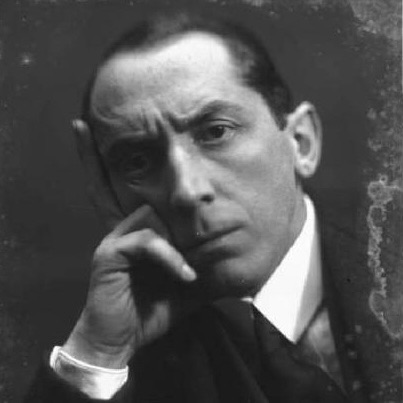
Italian painter and writer Umberto Boccioni was BOTD in 1882. Born in Reggio di Calabria, his father was a government employee, whose work required the family to move frequently, living variously in Forlì, Genoa, Padua and Sicily. In 1898, he moved to Rome, studying at the Accademia di Belle Arti di Roma and working with pontillist painter Giacomo Balla. After brief study visits to Paris and Venice, he settled in Milan in 1907, becoming a disciple of Futurist writer Filippo Marinetti. Boccioni applied Marinett’s theories to the visual arts, publishing Manifesti teorici del futurismo (The Technical Manifestos of Futurism) in 1910, encouraging artists to representate the speed and violence of modern technology. His paintings Riot in the Gallery and The City Rises, had a profound influence on the Vorticism movement when first exhibited in England. In 1912, he published a similar manifesto for Futurist Sculpture, advocating the use of non-traditional materials including glass, wood, cement, cloth and electric lights and the use of multiple materials in a single piece. His own scupture was more conservative in form and presentation, including his most famous piece, the plaster work Unique Forms of Continuity in Space. Discreetly bisexual, he had a long-term affair with composer Ferruccio Busoni. In 1915, he volunteered to fight for Italy during World War One, participating in the battle of Dosso Casina. In 1916, he was drafted into the Italian Army, dying after being thrown from a horse during a cavalry training exercise. He was 33. His death spelled the end of the Futurist arts movement, and much of his artwork was destroyed. Much of what is known of Boccioni’s life and work was recorded by Marinetti in his 1928 memoir. In 1931, Unique Forms was recast in bronze in 1931, and is now recognised as an important work in 20th century sculpture. In 1988, the piece was selected to appear on the Italian 20-cent Euro coin.
Umberto Boccioni

 Super Gays Born on this Day