
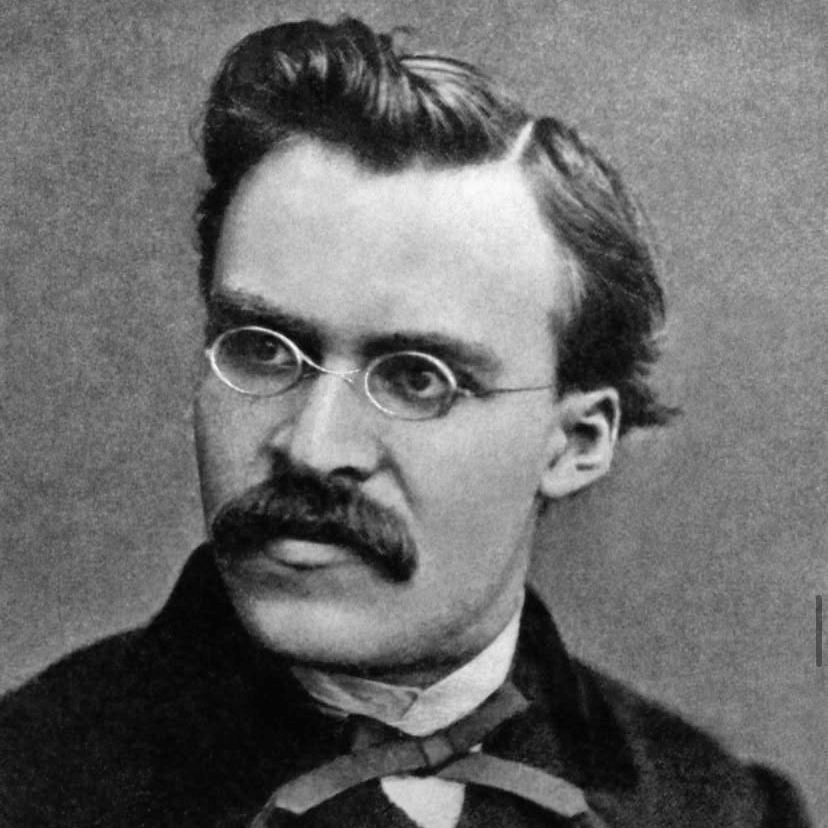
German writer and philosopher Friedrich Nietzsche was BOTD in 1844. Born in Röcken in the Kingdom of Prussia to a conservative Lutheran family, he was raised by his mother and aunts after his father’s death. He studied philosophy at the University of Bonn and later at the University of Leipzig, where he befriended the composer Richard Wagner. In 1869, he became a philology professor at the University of Basel, and volunteered as a medical orderly during the Franco-German War, becoming ill with diphtheria. He resigned a decade later due to recurring health problems, and turned to writing essays, cultural criticism, poetry and fiction. His first book Die Geburt der Tragödie aus dem Geiste der Musik (The Birth of Tragedy from the Spirit of Music) was published in 1872, setting out his theory of human existence as an eternal struggle between conflicting desires for order and chaos. In his 1885 treatise Also sprach Zarathustra (Thus Spake Zarathustra), self-published over three years, he rejected objective truth in favour of relativism, memorably declaring “Gott ist tot” (God is dead), and proposed the theory of the Übermensch (superman) as an ideal for humanity to aspire to. He developed his ideas of moral relativism in Jenseits von Gut und Böse (Beyond Good and Evil) and Zur Genealogie der Moral (On the Genealogy of Morality), critical studies of Platonic-Christian concepts of good and evil, in which he explained human behaviour as driven by der Wille zur Macht (the will to power). In 1889, he had a complete physical and mental breakdown and was briefly institutionalised, then cared for by his mother and sister until his death in 1900, aged 55. Largely unknown at his death, his writings were later promoted by his sister Elisabeth and widely adopted as justification for German nationalism during World War One and the rise of Adolf Hitler during the 1930s. His work has been hugely influential on 20th century philosophy, particularly in Existentialism, post-structuralism and postmodernism. More controversially, his writings were quoted approvingly by a number of murderers, including queer couple Nathan Leopold & Richard Loeb and “Moors Murderers” Ian Brady and Myra Hindley. Nietzsche never married and appears to have had no intimate relationships. In 2002, biographer Joachim Köhler argued that Nietzsche was homosexual and may have had a sexual relationship with his friend Paul Rée. Köhler and other biographers have also speculated that Nietzsche died of tertiary syphilis, contracting from visiting a (homosexual?) brothel.
Friedrich Nietzsche

 Super Gays Born on this Day