
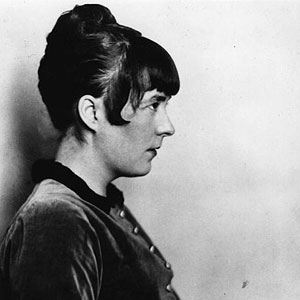
New Zealand writer Katherine Mansfield was BOTD in 1888. Born Kathleen Beauchamp in Wellington to a prosperous middle-class family, she began writing in her teens, and had her first lesbian relationship with her classmate Maata Mahupuku. She moved to London in 1903 to continue her education, where she met her lifelong friend (and probable lover) Ida Baker. She returned to New Zealand where she resumed her relationship with Mahupuku and had a two-year affair with Edith Bendall. Horrified by her behaviour, her family sent her back to England with an annual allowance, where she embraced Bohemian life. In 1908, she became pregnant to her friend Garnet Trowell, hastily entering into a marriage with singing teacher George Bowden, leaving him later that day. She later miscarried, channeling her experiences into her 1911 debut short story collection In a German Pension. She met and later married editor John Middleton Murry, co-editing the avant garde magazine Rhythm, and becoming exposed to the recently-translated short fiction of Anton Chekhov. Through Murry, she met and socialised with the key members of the Bloomsbury Group, and began publishing short stories. She and Murry had a complex, erotically-charged friendship with D. H. Lawrence and his wife Frieda, becoming estranged after Lawrence indiscreetly used them as the models for Gudrun and Gerald in his novels Women in Love and The Rainbow. She also had a lively, often combative correspondence with Virginia Woolf, who once described her as smelling like “a civet cat that had taken to street walking” but later admitted that her work “was the only writing I have ever been jealous of”. The death of Mansfield’s brother in World War One spurred Mansfield to address the “sacred debt” she owed him and her home country. In 1917, she separated from Murry and was diagnosed with tuberculosis later that year. She spent the next decade travelling to spa towns in Europe, often accompanied by Baker, and writing in between bouts of illness. Her first significant New Zealand-themed story, Prelude, was published by Leonard and Virginia Woolf’s Caxton Press in 1918. She rose to literary stardom with the 1920 publication of Bliss and Other Stories, followed by The Garden Party and Other Stories in 1922. While sometimes dismissed as an English-language acolyte of Chekhov, her stories were praised for their psychological insight – particularly into her thwarted female characters – with a clean, buoyant prose style and a deft use of shifting narrative perspectives. By 1922, seriously ill and in despair at not being able to return to New Zealand, she settled at a commune in Fontainebleau, France, led by Russian mystic Georges Gurdjieff. She died of a pulomary haemorrhage in 1923, aged 34. Relatively unknown at her death, her reputation grew after Murry’s publication of her writings and correspondence in 1927. The Katherine Mansfield Fellowship was founded in 1969, enabling a New Zealand writer to live and work in Mansfield’s former home in Menton, France. She had an explosion of popularity in the 1980s with the publication of biographies by Antony Alpers and Claire Tomalin and new editions of her work to celebrate the centenary of her birth. Now considered New Zealand’s greatest writer, she is recognised as a key figure in Modernist literature. She has been portrayed multiple times in films, documentaries and stage plays, notably by Vanessa Redgrave in the TV film A Picture of Katherine Mansfield, by Jane Birkin in the 1985 film Leave All Fair, and by Kate Elliott in the 2011 biopic Bliss.
Katherine Mansfield

 Super Gays Born on this Day