
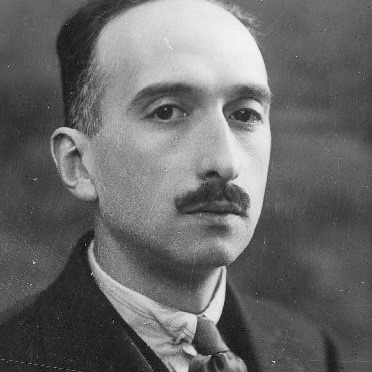
French writer, journalist and critic François Mauriac was BOTD in 1885. Born in Bordeaux to an upper-middle-class family, he was raised as a strict Roman Catholic, a faith he retained for the rest of his life. He studied at the University of Bordeaux before moving to Paris in 1906 to attend the École Nationale des Chartes, leaving soon after to pursue a career as a writer. He published a religiously-themed poetry collection Les Mains jointes (Joined Hands) in 1909, before finding greater success with his novels L’Enfant chargé de chaînes (Young Man in Chains) and La Robe prétexte (The Stuff of Youth), both featuring young male protagonists grappling with sin, grace and salvation. He became a literary star with his 1922 novel Le Baiser au lépreux (The Kiss to the Leper), followed by Le Désert de l’amour (The Desert of Love) and his 1927 novel Thérèse Desqueyroux, a religiously-infused rewriting of Émile Zola’s novel Thérèse Raquin. Following the success of his 1932 novel Le Noeud de vipères ( Vipers’ Tangle), he was elected to the Académie Française. He turned to playwriting in the late 1930s, finding success with his first performed play Asmodée in 1937. Like many Catholic writers, he was intensely concerned with the correct interpretation of his work, publishing the essay collection Le Romancier et ses personnages (The Novelist and His Characters), multiple volumes of his journals and three memoirs to explain and justify his literary methodology and moral values. During the 1930s, he became a vocal critic of Fascist governments in Germany, Spain and Italy, and worked with the writers of the French Resistance during World War Two. A longtime friend of military general Charles de Gaulle, he became a vocal supporter of de Gaulle’s political career and presidential campaigns. In 1952, he was awarded the Nobel Prize for Literature, praised by the Nobel Committee “for the deep spiritual insight and the artistic intensity with which he has in his novels penetrated the drama of human life”. After the war, he became an editor at Le Figaro newspaper, expressing strongly anti-Communist views, though criticising France’s ongoing colonisation of Indochina, Morocco, Tunisia and Algeria and opposing nuclear weaponry. In 1965, he had a public dispute with gay writer Roger Peyrefitte, following the publication of Peyrefitte’s novel Les Clefs de Saint-Pierre (The Keys of St. Peter), a blunt and sexually provocative satire of the Catholic Church. An enraged Mauriac threatened to resign as literary critic of L’Express if it continued to advertise Peyrefitte book. In response, Peyrefitte published an open letter to Mauriac in Arts magazine, outing him as a homosexual. Mauriac married Jeanne Lafon in 1913, with whom he had four children, remaining together until his death in 1970, aged 84. A 2009 biography by Jean-Luc Barré argued that Mauriac was sexually attracted to adolescent boys and young men, including the writers Bernard Barbey and Jean-Jacques Servan-Schreiber, though no evidence exists of his ever acting on his desires.
François Mauriac

 Super Gays Born on this Day