
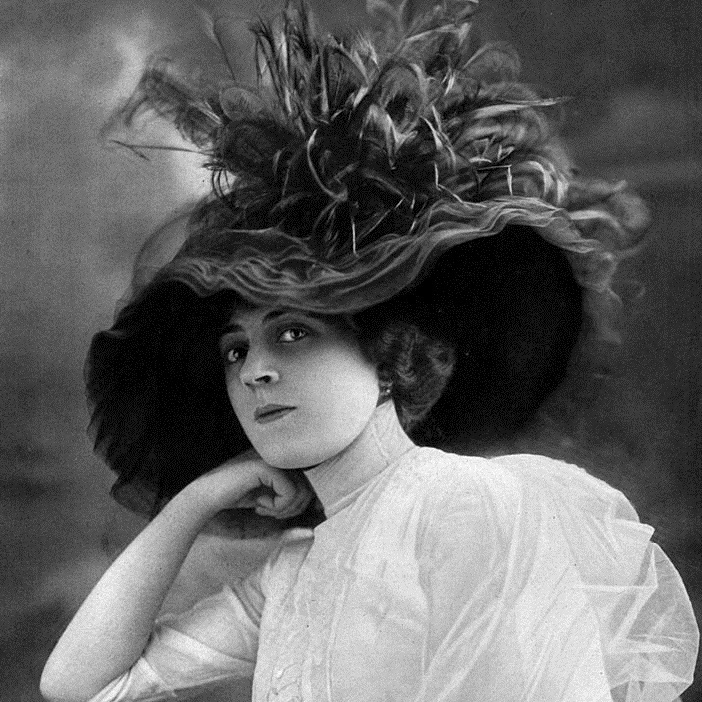
Russian dancer, actress and producer Ida Lvovna Rubinstein was BOTD in 1883. Born in Kharkov in the Russian Empire to a wealthy Jewish banking family, her parents died when she was a child, leaving her a vast fortune. At age 10, she was sent to St Petersburg to live with her aunt, where she was privately tutored, becoming fluent in multiple languages and studying music and dance. Inspired by dancer Isadora Duncan, she moved to Paris in 1908, performing onstage in a series of scandalously revealing costumes. Her horrified relatives had her committed to an asylum to protect the family name. Returned to St Petersburg, she was chaperoned constantly by governesses. She married her cousin Vladimir Gorvits in 1907, who allowed her to return to Paris and continue performing. After studying with choreographer Mikhail Fokine, she created a scandal during a private performance of Oscar Wilde‘s play Salomé, stripping nude while performing the Dance of the Seven Veils. Fokine recommended her to ballet impresario Sergei Diaghilev, who cast her in the title role of Cléopâtre in the Ballets Russes’ 1909 season. She later performed in Scheherazade, again choreographed by Fokine, shocking and titillating audiences with an erotic pas-de-deux with her co-star Vaslav Nijinsky. In 1911, she left the Ballet Russes to establish her own dance company, self-funded with her inheritance, commissioning a series of original works. Her notable productions included Maurice Ravel’s orchestral pieces Bolero and La Valse, performed as dance pieces with choreography by Fokine; the mystery play Le Martyre de saint Sébastien (The Martyrdom of Saint Sebastian), written by Gabriele D’Annunzio with music by Claude Debussy; and the ballets Le baiser de la fée (The Fairy’s Kiss) and Persephone, scored by Igor Stravinsky. Her performance as Saint Sebastian caused a public scandal due to a Jewish woman playing the revered saint, prompting the Archbishop of Paris to prohibit Catholics from attending. During the 1920s, she turned to classical drama, starring in Istar at the Paris Opera, and playing the title role in Alexandre Dumas fils‘ play Camille. Hailed as one of the great beauties of the age, she was the subject of portraits by Léon Bakst, Valentin Serov, Antonio de la Gandara and Jacques-Émile Blanche and the sculptor Demétre Chiparus. Openly bisexual, Rubinstein had a three-year relationship with painter Romaine Brooks, who created a series of nude paintings of her as Salomé. She had a longer and more profitable relationship with Walter Guinness, Lord Moyne, who funded many of her productions. Awarded the Légion d’honneur in 1934, she retired in 1935, giving her last public performance in the 1939 premiere of Paul Claudel’s oratorio Jeanne d’Arc au bûcher (Joan of Arc at the Stake). After the Nazi occupation of France, she fled to England in 1940, assisted by Lord Moyne, who bankrolled her four-year residency at the Ritz Hotel in London. While in London, she provided assistance to exiled Free French soldiers. After the war, she returned to France, settling in Vence on the Côte d’Azur. She died in 1960, aged 76.
Ida Rubinstein

 Super Gays Born on this Day