
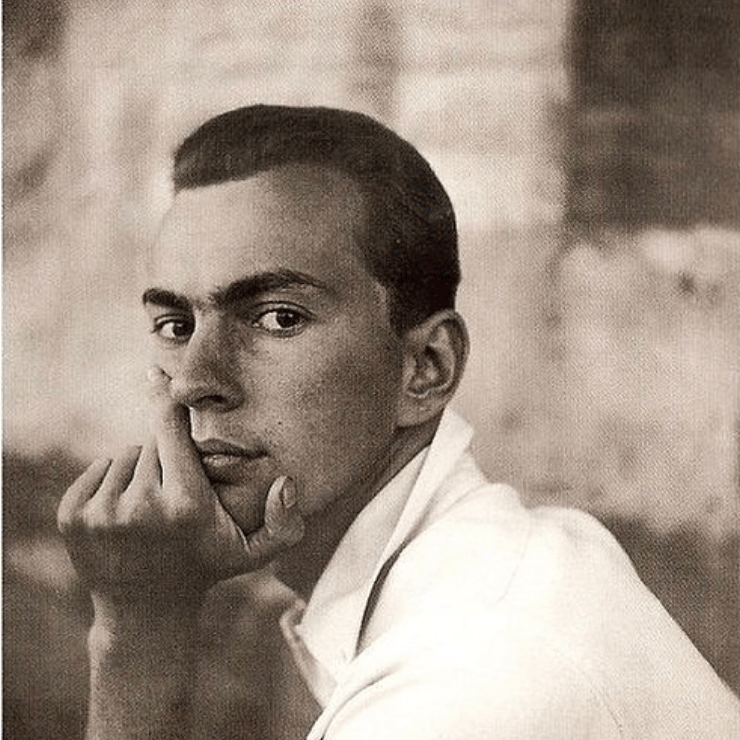
American writer and critic Gore Vidal was BOTD in 1925. Born in New York to a socially prominent family, he had a privileged upbringing, joining the US Army at 17 as America entered World War Two. After the war, he launched a career as a writer. His third novel The City and the Pillar, horrified 1940s America with its blatant unapologetic account of a war veteran coming to terms with his homosexuality. The book made Vidal famous but ended his aspirations for a political career. Somewhat bitterly, he carved out a career as a novelist, essayist, playwright, cultural critic and left-wing intellectual. A prolific writer of fiction, essays plays and historical biographies, his notable works include Myra Breckinridge, a satire about a ruthlessly ambitious trans woman conquering Hollywood, and a fictional account of Roman emperor Julian. In the 1950s, Vidal worked as a screenwriter for MGM, rewriting the script of Ben-Hur to suggest a homosexual attraction between Ben-Hur and Messala, and fighting with censors to retain the gay subtext in his 1959 adaptation of Tennessee Williams‘ play Suddenly Last Summer. Originally hired as the screenwriter for 1979’s Caligula, he had his name removed from the film’s credits after the script was rewritten to include more sex and violence. Relishing his public profile as an Evil Queen, he had well-publicised feuds with writers Truman Capote and Norman Mailer, encapsulating his world-view with the aphorism “It is not enough to succeed. Others must fail”. He was outed spectacularly during a 1968 live TV debate with conservative politician William F. Buckley, in which Buckley called him a “queer”. During the 1980s, he became a trenchant critic of Ronald Reagan, winning the National Book Award in 1993 for his collected political essays. In later life, he appeared in the films Bob Roberts, Gattaca and Igby Goes Down (the latter directed by his nephew Burr Steers). He baffled many by befriending and publicly defending Oklahoma bomber Timothy McVeigh, publishing their correspondence after McVeigh’s execution in 2001. Their friendship formed the basis of Edmund White‘s 2006 play Terre Haute, which the predictably enraged Vidal dismissed as the fantasies of a desperate “faggot”. In his 1995 memoir Palimpsest, Vidal claimed to have had affairs with thousands of men by his mid 20s, and listed Anaïs Nin, Fred Astaire and Dennis Hopper among his many celebrity lovers. He was in a long-term relationship with Howard Austen from 1950 until the latter’s death in 2003, the longevity of which Vidal credited to their relationship being sexless. Vidal died in 2012 aged 86. A Netflix biopic starring Kevin Spacey as Gore was filmed in 2017 but remains unreleased. His infamous TV debate with Buckley was dramatised in James Graham’s 2021 play Best of Enemies, starring Charles Edwards and latterly Zachary Quinto as Vidal.
Gore Vidal

 Super Gays Born on this Day