
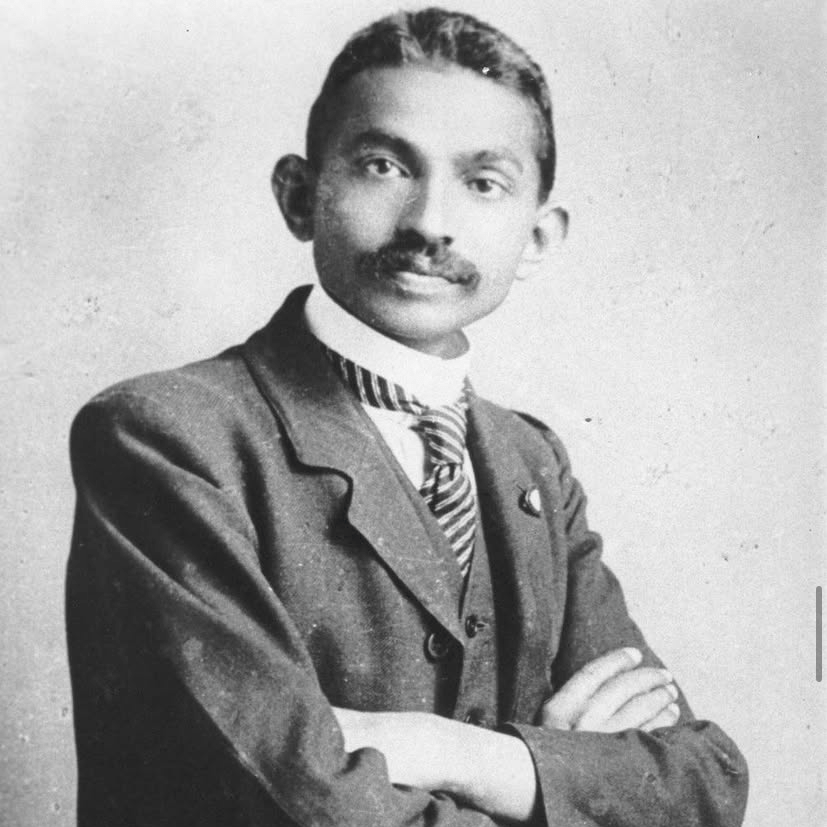
Indian activist and politician Mahatma Gandhi was BOTD in 1869. Born to a Hindu family in Porbandar, Gudurat, he studied at the University of Bombay (now Mumbai) before training as a barrister in London, where he first read the Bhagavad Gita and encountered writings of social reformers Edward Carpenter and George Bernard Shaw. After briefly returning to India, he took up a job offer at an Indian law firm in British-controlled South Africa. After repeated experiences of racial discrimination, he joined protests against a law to deny Indians the vote. In 1894, he founded the Natal Indian Congress, drafting petitions to the local and British governments, drawing international attention to South Africa’s record of institutionalised racism. Over seven years, he developed a practice of non-violent resistance to protest civil rights violations, resulting in multiple arrests and jail sentences. He returned to India in 1915, assuming leadership of the Indian National Congress where he led nationwide campaigns against British rule, including boycotts of British manufactured goods and protests against a tax on salt. While in prison, he led a hunger strike to protest the segregation of the Dalits (“untouchables”). In 1934, he abandoned politics in favour of a grassroots programme to rebuild the local economy and educate rural Indians. With the outbreak of World War Two, he returned to public life, demanding an immediate British withdrawal from India. His Gandhi’s vision of an independent multi-faith India was destroyed by the 1947 Partition, engineered by Lord Mountbatten, creating a Hindu-majority India and Muslim-majority Pakistan and displacing millions of citizens. Determined to heal divisions, he travelled the country, visiting refugee camps and leading fasts to stop public rioting. He was assassinated in 1948, aged 78. Dubbed “The Father of the Nation”, his birthday became a national holiday in India. Now considered one of the most influential politicians in the world, his theories of non-violent resistance transformed the art of protest in post-World War Two society, adopted by American civil rights activists Bayard Rustin and Martin Luther King, anti-colonialist and independence movements in Europe, Africa and Australasia and by HIV/AIDS protest group ACT-UP. Gandhi married Kasturba Kapadia in 1882 when she was 13, with whom he had four children, practising celibacy in later life. In his 2011 biography Great Soul: Mahatma Gandhi and His Struggle With India, Kasturbai quoted letters written by Gandhi to German bodybuilder Hermann Kallenbach, suggesting their mutual sexual attraction. (“How completely you have taken possession of my body“, reads one widely-quoted letter; “This is slavery with a vengeance.”) Lelyveld later clarified that the relationship was unlikely to have been sexual due to Gandhi’s religious beliefs. Perhaps unsurprisingly, his book has been banned in India.
Mahatma Gandhi

 Super Gays Born on this Day