
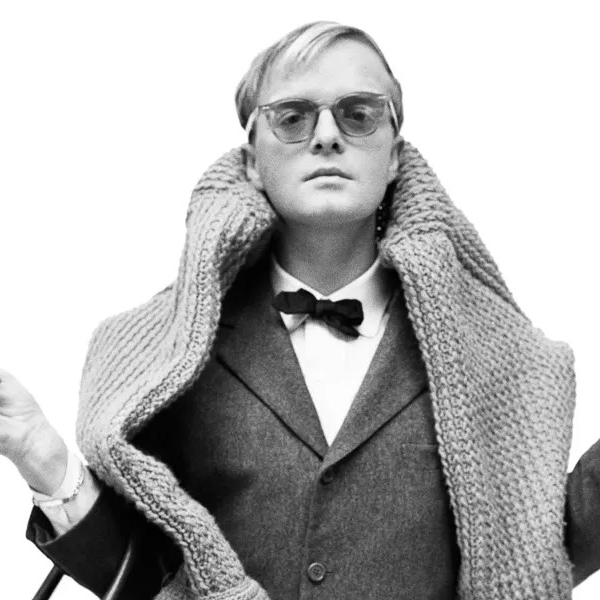
American writer and socialite Truman Capote was BOTD in 1924. Born in New Orleans, Louisiana, his parents separated when he was an infant, and he lived an itinerant life with his mother. At four, he was sent to live with his aunts in Monroeville in rural Alabama, befriending the tomboy next door named Nelle Harper Lee. He moved to New York in his teens, establishing himself a short story writer. In 1946, he won the O. Henry Award and attended the artists’ colony Yaddo in upstate New York, where he met and formed a relationship with academic Newton Arvin. His 1948 debut novel Other Voices, Other Rooms, a Southern Gothic coming-of-age drama with an unabashed queer subtext, attracted both praise and controversy, inflamed by Harold Halma’s sexually provocative publicity photo. His next fiction project, Breakfast at Tiffany’s, was originally written for Harpers Bazaar magazine but was rejected for its risqué content and language. Published in book form in 1958, it became a national sensation, introducing the character of party-girl Holly Golightly and establishing Capote as the leading prose stylist of his generation. Capote was horrified by the resulting film adaptation, which cast the brunette Audrey Hepburn as the Marilyn Monroe-esque Holly and de-queered the story’s gay protagonist, but enjoyed the resulting wealth and celebrity. Physically tiny, overtly camp, gregarious and fabulously dressed, he wore his queerness openly, attracting a circle of wealthy society wives including Babe Paley, Slim Keith and Lee Radziwell, whom he nicknamed his “Swans”. In 1960, he collaborated on the screenplay of the Gothic horror film The Innocents, a well-received adaptation of Henry James‘ novella The Turn of the Screw. He spent seven years writing and researching In Cold Blood, an account of the real-life murder of a Kansas farming family by sociopathic drifters Richard Hickox and Perry Smith. With the help of Lee, Capote interviewed and befriended the friends, family and police officers involved in the case. He is thought to have bribed prison officials to give him access to the killers, assisting them with their legal appeals to keep them alive, and developing an intimate, erotically-charged friendship with Smith. Realising that he needed them dead to be able to finish the book, he withdrew his help, eventually attending their executions. Published in 1967 in the New Yorker magazine and later in book form, In Cold Blood made Capote the most famous writer in America, and is credited with popularising the non-fiction novel genre. The psychological toll of the project and his complicity in Smith’s and Hickox’s deaths exacerbated his dependency on alcohol and barbituates. In 1966, he hosted the Black and White Ball, a now-legendary event with a guest list blending old New York society with Hollywood celebrities and pop culture figures. Later that year, he signed a publishing contract for his next book Answered Prayers, which he claimed would be a contemporary American version of Marcel Proust‘s novel In Search of Lost Time. After nearly a decade, he published an initial chapter in Esquire magazine in 1975. The publication of the next chapter, La Côte Basque caused a scandal, as his Swans objected to his unflattering portraits of their lives. Shunned by much of New York society, Capote relocated to Los Angeles, sinking further into addiction and making chaotic appearances on TV talk shows. Capote had a long-term open relationship with writer Jack Dunphy, living together intermittently from the late 1950s until the 1970s, and remaining friends for the rest of his life. In his later years, he had an abusive relationship with John O’Shea, who attempted to take control of his literary and business interests. He died in 1984 of complications due to alcoholism, aged 59. When told of his death, Capote’s arch nemesis Gore Vidal called it “a wise career move”. He has been portrayed many times onscreen, notably by Philip Seymour Hoffman in the 1995 film Capote, winning Hoffman an Oscar; by Toby Jones in a competing biopic, Infamous; and by Tom Hollander in the Ryan Murphy-produced TV series Feud: Capote vs The Swans, chronicling the writing and aftermath of Answered Prayers.
Truman Capote

 Super Gays Born on this Day