
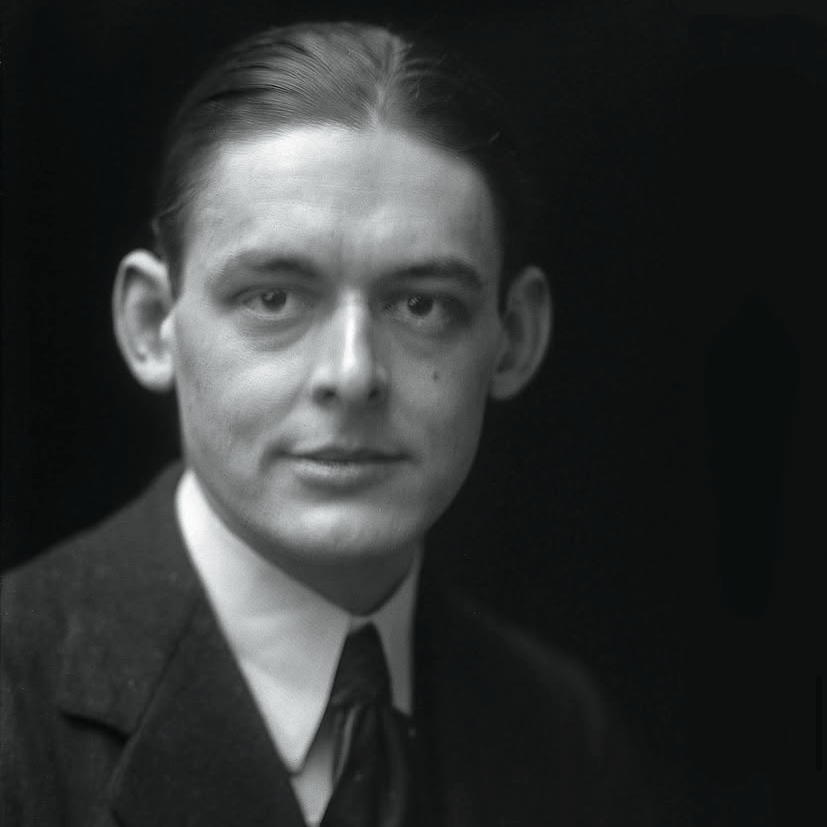
American poet, playwright, editor and critic Thomas Sterns (T. S.) Eliot was BOTD in 1888. Born in St Louis, Missouri to a prominent New England family, he was educated at private schools and attended Harvard University, moving to Paris in 1910 to continue his studies at the Sorbonne, where he met expatriate writers Gertrude Stein, Ernest Hemingway and Ezra Pound. He rose to public attention with his debut poetry collection Prufolk and Other Observations. Its title poem, The Love Song of J. Alfred Prufolk, an ode to suburban male despair, was hailed as a masterpiece of the emerging Modernist movement. Settling in London, where he worked as a teacher and a bank clerk, he befriended Leonard and Virginia Woolf and other members of the Bloomsbury Group. He is best known for his poem The Waste Land, first published by the Woolfs’ printing press in 1922. Echoing the collage technique of Modernist painting, the poem dazzled readers with its abrupt shifts of poetic styles, overlapping narratives and multiple voices, with a dizzying number of allusions to Ovid’s Metamorphoses, Dante’s Divine Comedy, Chaucer’s The Canterbury Tales, Arthurian legends of the Holy Grail, Vedic and Sanskrit texts and contemporary popular songs. Hailed for its articulation of post-war existential despair, it established Eliot’s international reputation. His themes of urban malaise and were further explored in the poems The Hollow Men, Ash Wednesday and Four Quartets, while his 1935 verse drama Murder in the Cathedral, recounting the murder of Thomas Becket, reflected his lifelong attraction to the rigours of religious faith. Eliot was also a prominent literary critic, becoming a leading exponent of the New Criticism, rejecting biographical and psychoanalytic analysis in favour of a text-based approach to literary criticism. He worked as an editor at English publishing firm Faber & Faber from the early 1920s until his death, publishing and promoting the work of W. H Auden, Stephen Spender, Djuna Barnes, Ted Hughes and Philip Larkin. In 1948, he was awarded the Nobel Prize for Literature. Eliot married Vivienne Haigh-Wood in 1915. Their marriage was childless (and possibly sexless), complicated by Eliot’s reserve and Haigh-Wood’s mental illness. They separated in 1933; five years later, Haigh-Wood’s brother had her committed to an asylum, apparently with Eliot’s consent. Eliot refused to visit Haigh-Wood in hospital, and she remained there until her death in 1948. In 1957, Eliot married his secretary Valerie Fletcher, remaining together until his death in 1965 aged 76. His sexuality has been debated extensively by biographers and critics, with particular attention paid to his aversion to sex and his friendship with a French soldier, Jean Verdenal, to whom Prufrock was lovingly dedicated. Valerie worked as Eliot’s literary editor until her own death in 2012, vigorously insisting on her husband’s heterosexuality. In 1983, Eliot’s light verse collection Old Possum’s Book of Practical Cats became a surprise bestseller when it was adapted by Andrew Lloyd Webber into mega-musical Cats. Eliot was portrayed by Willem Dafoe in the 1994 biopic Tom & Viv, based on Michael Hastings’ play about Eliot’s unhappy relationship with Haigh-Wood and his involvement in her committal.
T. S. Eliot

 Super Gays Born on this Day