
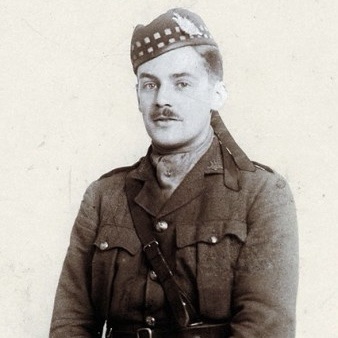
Scottish writer and translator Charles Kenneth (C. K.) Scott Moncrieff was BOTD in 1889. Born in Weedingshall, Stirlingshire to a prominent middle-class family, he studied at Winchester College in England, where he befriended literary homosexuals Christopher Sclater Millard and Robbie Ross. In 1908, he published the short story Evensong and Morwe Song in the college’s magazine, creating a scandal with its implied descriptions of two schoolboys practising fellatio. He remained at the school, though the poem’s notoriety is thought to have denied his acceptance to Oxford University. He attended the University of Edinburgh, where he had a long relationship with Cambridge undergraduate Philip Bainbrigge. At the outbreak of World War One, Scott Moncrieff was given a commission in the King’s Own Scottish Borderers, and was wounded in battle at the Western Front, leaving him permanently disabled. After his military discharge, he worked at the War Office in London, contributing reviews to the literary magazine New Witness, and cultivating friendships with gay writers Noël Coward, Robert Graves and a passionate, possibly sexual relationship with Wilfred Owen. Concerned about Owen’s return to battle, he unsuccessfully tried to secure him a “safe” war posting in England. Owen’s death in 1918, a week before the Armistice, earned Scott Moncrieff the enmity of Owen’s homosexual friends Osbert Sitwell and Siegfried Sassoon. After the war, he worked for press baron Lord Northcliffe, eventually becoming an editor for The Times of London. Following the success of his 1919 translation of the Anglo-Saxon epic Beowulf, he persuaded the publishers Chatto & Windus to let him undertake an English-language translation of Marcel Proust‘s multi-volume novel À la recherche de temps perdu. Departing from literal translation in favour of a poetic rendition of Proust’s text, he retitled the first volume Remembrance of Things Past, a quote from William Shakespeare‘s Sonnet 30. Proust was initially horrified by reports of the translation’s “hopeless inaccuracies”, though was charmed by the results, writing to Scott-Moncrieff to thank him for his efforts, praise his talent and correct his spelling. Scott Moncrieff moved to Rome in 1923 for his heath, where he worked on five further volumes of Remembrance, making him a literary celebrity. His other translation projects included Stendahl’s novel Le Rouge et le Noir (The Red and the Black), the writings of Luigi Pirandello and the letters of horny medieval clerics Abelard and Heloise. He died of cancer in 1930, aged 40, leaving the translation of Proust’s final volume to his colleague Sydney Schiff. Remembrance of Things Past became the standard translation of Proust in the English-speaking world for over 50 years, and remains a bestseller, still favourably compared with contemporary translations for the beauty of its prose style. The Society of Authors awards the Scott Moncrieff Prize annually for the best English-language translation of French literature.
C. K. Scott Moncrieff

 Super Gays Born on this Day