
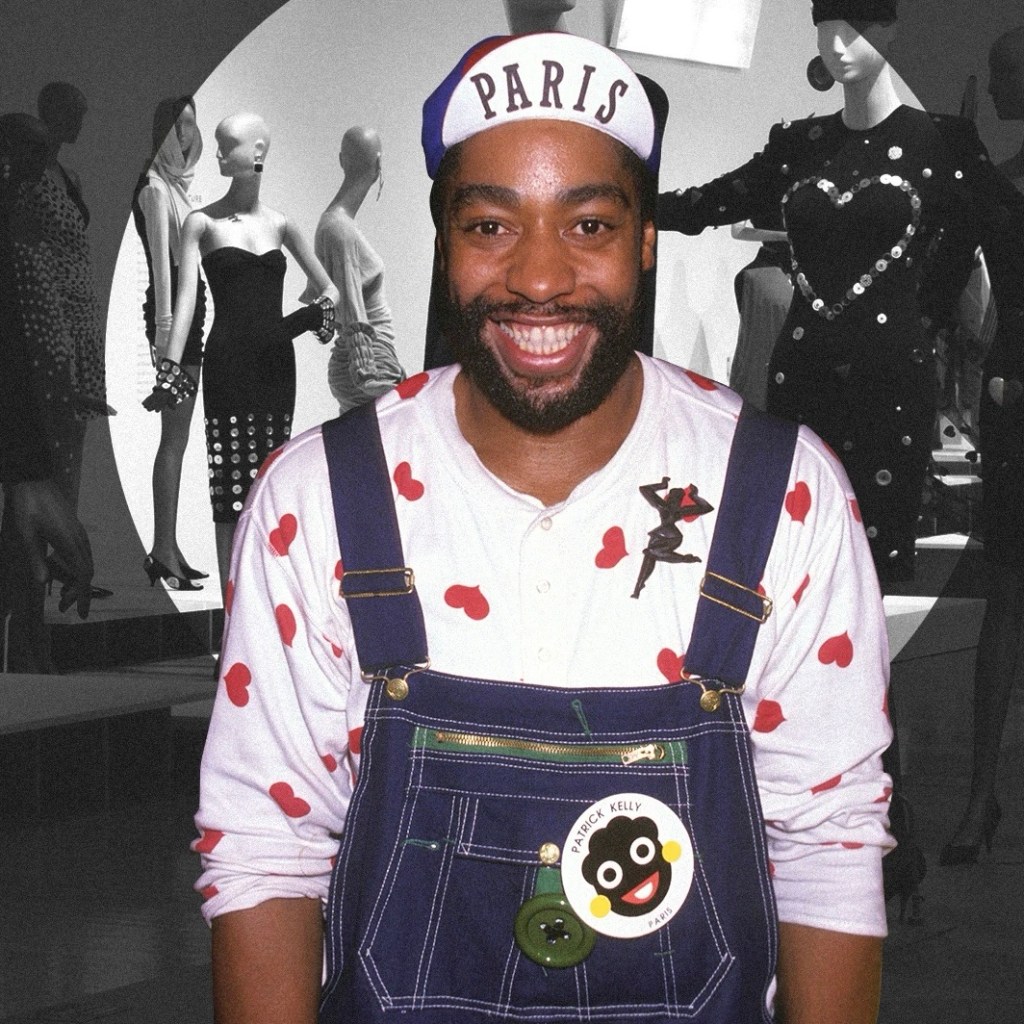
American fashion designer Patrick Kelly was BOTD in 1954. Born in Vicksburg, Mississippi, he developed an interest in fashion design in high school, where he learned to sew. He briefly attended Jackson State University before moving to Atlanta, Georgia, where he began making and selling clothes in a thrift store. Encouraged by Black supermodel Pat Cleveland, he moved to New York City to pursue a career in fashion design. A year later, again at Cleveland’s suggestion, he moved to Paris, France, where his brightly coloured jersey dresses became an immediate success. In 1983, he formed a relationship with Björn Amelan, who took over the management of Kelly’s career. His designs surged in popularity after appearing in French Elle magazine, and his tailored suits and dresses, adorned with bows and coloured buttons, were worn by celebrity clients including Bette Davis, Paloma Picasso, Grace Jones, Madonna, Cicely Tyson, Goldie Hawn and Gloria Steinem. His work frequently appropriated racist symbols of Black identity, including watermelon wedges, bananas and golliwogs, or clothes trimmed with gardenias in tribute to Black performers Hattie McDaniel and Billie Holiday. In 1987, he signed a manufacturing agreement with the Warnaco fashion conglomerate, who sold his designs around the world. The following year, he became the first American designer to be admitted to the Chambre syndicale du prêt-à-porter des couturiers et des créateurs de mode, joining esteemed alumni including Coco Chanel, Christian Dior and Yves Saint-Laurent. In 1989, he won a contract to design for Benetton, and developed plans to expand into lingerie, perfume and menswear. Openly gay since forever, he was a long-time friend and lover of the choreographer Bill T. Jones. His career came to a standstill in 1989 when he was diagnosed with HIV, quickly becoming ill as he developed full-blown AIDS. He died in 1990 aged 35, and buried in Père-Lachaise cemetery in Paris, with a golliwog adorning his gravestone.
Patrick Kelly

 Super Gays Born on this Day