
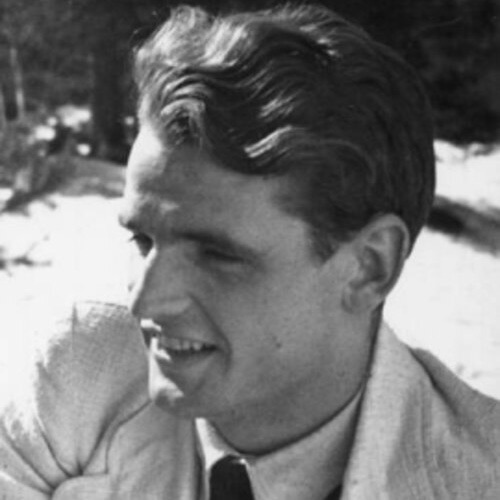
German activist and dissident Hans Scholl was BOTD in 1918. Born in Ingersheim in the German Empire to a prominent political family, his father was mayor of Forchtenberg am Kocher. He grew up during the rise of the Nazi Party, and became an enthusiastic member of the Hitler Youth, against his father’s wishes, taking part in the 1935 Nuremberg Rallies. In 1937, he was arrested because of his membership of the Deutsch Jungenschaft (German Young Comrades), a youth organisation recently banned by the Nazis. He was also charged under Paragraph 175 of the German Penal Code for homosexual behaviour, confessing at trial to having relationships with his friends Rolf Futternecht and Ernest Reden. Granted clemency by the trial judge, he was discharged without a criminal record. Reden, as the elder of the two, was found guilty and sent to a concentration camp. He later studied medicine at the Ludwig Maximilian University in Munich, encountering teachers and students who were critical of Fascism, prompting him to rethink his loyalty to the Nazi regime. At the outbreak of World War Two, he was despatched to the Eastern Front as a medical sergeant, reinforcing his anti-Nazi and pacifist beliefs. He returned to Munich in 1942, and began writing anti-war pamphlets with his friend Alexander Schmorell, distributing them in universities and public phone booths. After a second tour of duty at the Russian Front, he and Schmorell stepped up their campaign, which became known as Weiße Rose (the White Rose), joined by mutual friend Willi Graf and Scholl’s younger sister Sophie. In 1943, Hans, Sophie and their colleague Christoph Probst were arrested while distributing leaflets at Munich University. During his interrogation, Hans attempted to exonerate Sophie and Probst by claiming to have distributed the leaflets himself. All three were found guilty of treason and condemned to death. Originally sentenced to a public hanging, Nazi officials, anxious to avoid their being immortalised as martyrs, arranged for them to be taken to Stadelheim Prison, where they were executed by guillotine later that day. At the time of their deaths, Hans was 24 and Sophie was 21. Their execution was reported around the world, and condemned by exiled German writer Thomas Mann, who praised the courage of the White Rose in a radio broadcast. Later that year, the Allied Forces dropped millions of copies of one of the White Rose’s leaflets, retitled The Manifesto of the Students of Munich, across cities in Germany. After the war, the Scholls and other White Rose members were hailed as heroes, and credited with prompting meaningful resistance within Germany to the Nazi regime. Among many posthumous honours, the square outside Munich University was renamed Geschwister-Scholl-Platz, while a lecture hall at Bundeswehr Medical Academy in Munich was named after Hans. The Geschwister-Scholl literary prize is awarded annual by the city of Munich for a book which “shows intellectual independence and supports civil freedom, moral, intellectual and aesthetic courage and that gives an important impulse to the present awareness of responsibility”. Hans has been portrayed in TV and film biopics by Michael Cornelius, Wulf Kessler and Fabian Hinrichs.
Hans Scholl

 Super Gays Born on this Day