
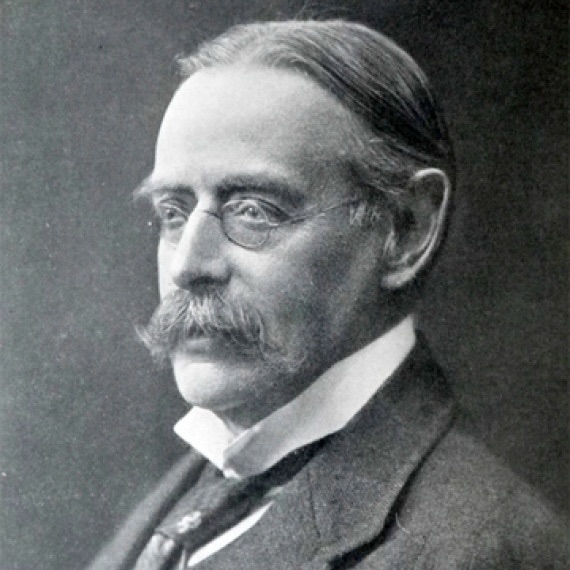
English writer, historian, critic and poet Edmund Gosse was BOTD in 1849. Born in London, he was raised in Torquay in Devon after the death of his mother. Raised in the conservative Protestant sect the Plymouth Brethren, he was forbidden access to non-religious poetry and novels until his teens. In 1865, he moved to London to work for the British Library, and became a translator for the Board of Trade. In 1872, he visited Denmark and Norway, meeting children’s author Hans Christian Andersen and being introduced to the work of Norwegian playwright Henrik Ibsen. A prolific writer, he wrote nine collections of poetry, a series of well-regarded histories of English literature, biographies of writers John Donne, Thomas Gray and William Congreve and critical studies of Victorian sculpture, and edited the 1911 edition of Encyclopaedia Britannica. His 1885 book From Shakespeare to Pope, based on a series of lectures given in America, created a scandal after critics pointed out inaccuracies in Gosse’s research, prompting an impassioned public debate about “dilettantes” being allowed to teach English literature. He befriended most of the literary and artistic luminaries of his generation, including Alfred Lord Tennyson, Robert Browning, Algernon Charles Swinburne, Robert Louis Stevenson, Thomas Hardy, John Singer Sargent, Henry James and André Gide. He is perhaps best remembered for translating Ibsen’s plays The Master Builder and Hedda Gabler into English, and credited with introducing Ibsen’s naturalistic drama to British audiences. He also published an English translation of Alexandre Dumas fils novel La dame aux camelias (The Lady of the Camelias). In later life, he became chief librarian of the House of Lords, lecturing in English literature at Cambridge University and supporting the literary careers of W. B. Yeats, James Joyce and Siegfried Sassoon. His 1907 memoir Father and Son recounted his escape from his puritanical family into the world of letters. Gosse married the heiress Ellen Epps in 1875, with whom he had three children. His marriage, while happy, provided a cover for his closeted homosexuality. He had an intimate, erotically-charged friendship with the sculptor Hamo Thornycroft, and wrote to his friend John Addington Symonds about the “wild beast” inside himself: “He is not dead, but tamer; I understand him & the trick of his claws.” After Symonds’ death in 1893, Gosse was appointed his literary executor, destroying all Symonds’ manuscripts about homosexuality, only allowing the (censored) publication of Symond’s unfinished autobiography. Gosse was knighted in 1925, dying in 1928, aged 78. He was portrayed by Max Harris in the 1976 TV play Where Adam Stood, adapted from Father and Son.
Edmund Gosse

 Super Gays Born on this Day