
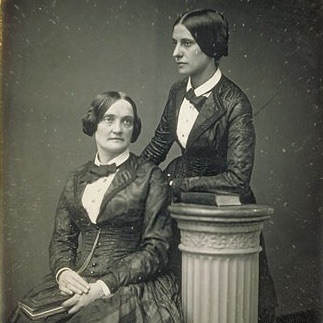
American journalist and activist Matilda Hays was BOTD in 1820. Born in London to a wealthy mercantile family, her mother died when she was 12, and she was raised by her aunt Mary Hays, a well-known writer and feminist, who became her primary educator. Following in her aunt’s footsteps, she pursued a career as a writer, producing a much-admired series of translations of cross-dressing queer novelist George Sand, establishing her reputation in London literary society. After collaborating with her friend Eliza Cook on a self-published periodical, she co-founded the feminist periodical The English Women’s Journal, writing extensively about women’s rights, temperance and social support for the poor. She also co-founded the independent printing press the Victoria Press, and was heavily involved Society for Promoting the Employment. Openly and unapologetically lesbian, she dressed in men’s attire from the waist up (continuing to wear skirts in a nod to social respectability) and lived openly with at least three women. Her most famous relationship was with sculptor Charlotte Cushman, whom she met in 1848. They scandalised Victorian society by appearing together in public, dressed identically, and briefly appeared on stage together in Bath. They relocated to Rome in 1852, where they headed a lesbian expatriate community. Their relationship was turbulent, punctuated by mutual affairs with other women and ending with an explosive separation in 1857. Hays later had relationships with poet Adelaide Anne Procter, who dedicated her 1858 collection Legends and Lyrics to her, and with her friend and patroness Theodosia, Baroness Monson. She died in 1897, aged 76.
Matilda Hays

 Super Gays Born on this Day