
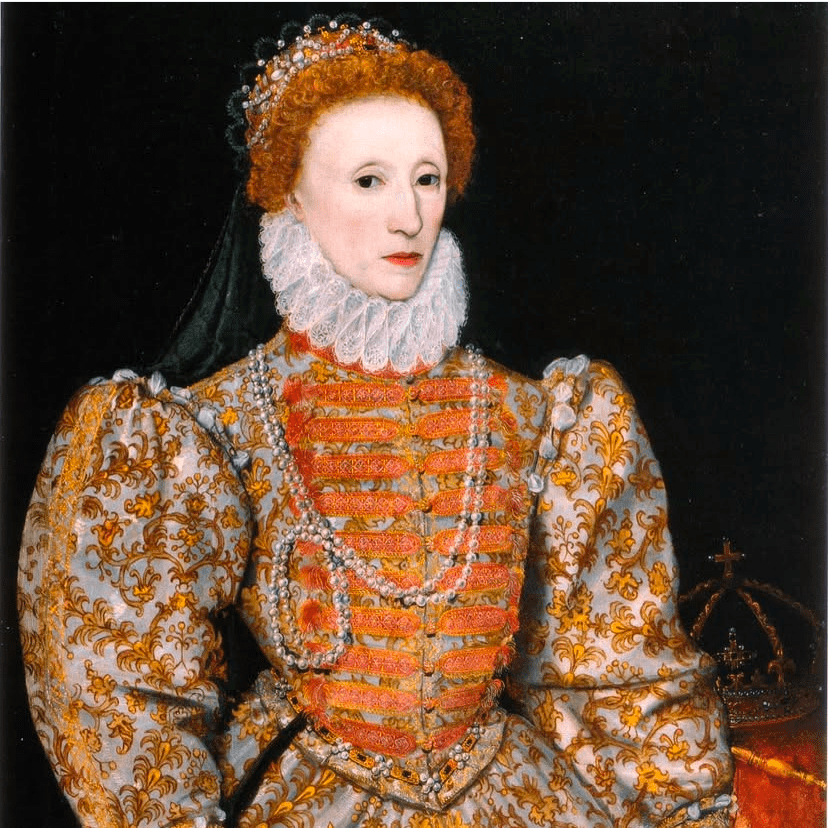
English monarch Queen Elizabeth I was BOTD in 1533. Born in Greenwich Palace in London, the daughter of King Henry VIII and his second wife Anne Boleyn, her mother was executed when she was two years old. Declared illegitimate, she was banished from the Royal court as her half-sister Mary became queen, and grew up at Hatfield House in Hertfordshire. Raised a Protestant, she was eventually named third in line to the throne. She received a rigorous education, becoming adept in Greek, Latin, French and Italian and studying history, rhetoric, moral philosophy and theology, prompting her tutor Roger Ascham to comment approvingly “Her mind has no womanly weakness”. After Henry’s death in 1547 and the early death of her half-brother King Edward VI, she became the centre of Protestant plots to overthrow the Catholic Mary. Arrested in 1554, she was imprisoned in the Tower of London and accused of treason, avoiding execution by steadfastly pledging her loyalty to Mary and the Catholic Church. After Mary’s death in 1558, she was crowned Queen, aged 26. She set about restoring the war-torn country’s fortunes via trade and seafaring, and promoted religious tolerance, re-establishing Protestantism as the state religion but famously stating “I have no desire to make windows into men’s souls“. After the fortuitous defeat of the Spanish Armada, she largely avoided wars with rival countries, avoiding marriage proposals from allies to retain her political neutrality and independence. An enthusiastic patron of the arts, she promoted a flowering of music and literature that became known as England’s “Golden Age”. Among the artists whose careers flourished under her reign were the poets Edmund Spenser and Philip Sidney, playwrights William Shakespeare and Christopher Marlowe, and composers William Byrd, John Dowland, Orlando Gibbons, John Taverner and Thomas Tallis. Elizabeth never married or had children, styling herself as the Virgin Queen, forever married to her country. In 1588, she famously addressed her troops on horseback, dressed in armour, declaring “I know I have the body of a weak and feeble woman; but I have the heart and stomach of a king, and of a king of England too.” Her adeptness at embodying a “masculine” position of power and her continuing childlessness prompted rumours that she was sexually abnormal or a hermaphrodite. Her lovers are thought to have included Robert Dudley and Robert Devereux, though the exact details of her intimate relationships continue to be debated by historians and biographers. After years of hesitation, she finally ordered the execution of her cousin Mary Queen of Scots in 1567, a Catholic and her most serious rival to the throne. Elizabeth died in 1603 aged 69, and was succeeded by Mary’s son (and notorious homosexual) James I & VI. Now considered one of Britain’s greatest monarchs and a brilliant political strategist, her life has inspired innumerable books, plays and films. She has been played on stage and screen by Sarah Bernhardt, Bette Davis, Glenda Jackson, Jenny Runacre, Helen Mirren, Cate Blanchett, Judi Dench and Quentin Crisp.
Queen Elizabeth I

 Super Gays Born on this Day